The Greenville News editorialist Nell Stewart could not have more clearly highlighted the innovator's dilemma in public education.
Public schools are designed for children of middle income, educated parents. It is assumed that parents will be active in the PTA, will be close partners with their children's teachers, and will do hours of homework with their children when they get home.
But what if parents either can not or will not be as active in their children's education as middle income, educated parents?
Nell's solution is the parents must change. "All of us must be responsible for our own actions, and effectively help others to accept their own responsibility."
Failing organizations usually blame the customer. You hear, "Customers don't' get it - there is no way we can do it for that cost ... or in that time frame ... or at that level of quality. If customers would only change we could be successful."
No where in Nell's editorial is there any suggestion that the model of delivering education must change. No where does Nell appreciate that who is likely to identify novel new ways of delivering innovative education are educational entrepreneurs. No where does Nell appreciate that entrepreneurs have no opportunity to do what only they can do best in the current system; that to have fundamentally better public education, we need new and innovative methods of delivering education to those poorly served by the current system.
Until we understand that and act on it, we won't make the progress we need to in becoming more globally competitive as a community.
Saturday, June 18, 2005


Sunday, June 12, 2005
When waves crash on the beaches of our lives
We plan. We strategize. We pontificate. We enjoy the illusion that we are in control. And then the waves come crashing over the sea walls we erect to protect ourselves from the outside world.
I was sharing some work problems with a friend earlier in the week, and she asked was I happy. I told her about another friend who had a critically ill relative and said that helps put our problems in perspective. My friend got defensive and said there was more to life than not having pain, which wasn't what I said, but ...
Then Friday, my mother's minister called. Mama had been teaching Vacation Bible School earlier in the week and had gotten disoriented and confused. She picked up her grandchild to take him home, only the child she picked up was not her grandchild. With the child screaming, mama argued with the other workers that she was right and to let her go and ...
When I called mama Friday to ask if she was OK, she insisted everything was fine. It seemed like a casual check-up call at first, until I asked if she had become disoriented earlier in the week. "Well no, why would you ask that?" As I got more specific, she got more irritated. "Who have you been talking to?" Getting off the phone, she thanked me for being concerned, insisted she was quite alright, but that wasn't the last call of the day ...
Saturday, mama's first cousin and I went to Charleston to bring mama to Anderson to stay with her cousin for at least a few days. We stopped at a restaurant for lunch. Our cousin ordered a salad with cheese and broccoli soup. Mama was looking at her menu and didn't remember what the soup choices were, so she asked the waitress again. "A salad with cheese and broccoli soup is what I'll have, too," mama ordered ...
Within ten minutes, we had gone to the salad bar and were back at our table when they brought the soup. The waitress gave one soup to our cousin and the other to my mother. My mother said she didn't order the soup, and when we told her she did, she got very insistent that she didn't ...
My stomach tightened. The pain on my face as I looked at our cousin said more than I could have verbalized at that point.
We don't know what's wrong. Mama has been under a lot of stress. Is it as simple as that? Did she have a small stroke? Could it be Alzheimer’s, with all the terror and dread that implies? We just don't know.
Our cousin and I later discussed what we might need to do. She said, "I'll take care of your mother, but you'll have to take care of the house in Charleston, contact her stockbroker about her investments, and get her bills paid."
I stopped by my mother's house about a month ago for a very brief visit. She was anxious about her finances and asked me to go downtown to meet with her stockbroker. I had to get back home to Greenville that day so didn't have time. I've meant to schedule a day to do that, but never did. I wish I had. Maybe mama was trying to tell me something she couldn't tell me directly. Now I'll have to find the time in my calendar to attend to what I should have paid attention to already.
When we got to my house Saturday night, my wife had been working hard all day fixing a wonderful dinner. It was delightful and comforting given the day that we'd had. After dinner, my mother was off to our cousin's house to stay for awhile.
We do have protection from the major storms in our lives. But it is not because we are in control ... in an instant that can be exposed for the illusion that it is. Often our sea walls are the people who love us and do what they can to protect us from the most violent waves.
I was sharing some work problems with a friend earlier in the week, and she asked was I happy. I told her about another friend who had a critically ill relative and said that helps put our problems in perspective. My friend got defensive and said there was more to life than not having pain, which wasn't what I said, but ...
Then Friday, my mother's minister called. Mama had been teaching Vacation Bible School earlier in the week and had gotten disoriented and confused. She picked up her grandchild to take him home, only the child she picked up was not her grandchild. With the child screaming, mama argued with the other workers that she was right and to let her go and ...
When I called mama Friday to ask if she was OK, she insisted everything was fine. It seemed like a casual check-up call at first, until I asked if she had become disoriented earlier in the week. "Well no, why would you ask that?" As I got more specific, she got more irritated. "Who have you been talking to?" Getting off the phone, she thanked me for being concerned, insisted she was quite alright, but that wasn't the last call of the day ...
Saturday, mama's first cousin and I went to Charleston to bring mama to Anderson to stay with her cousin for at least a few days. We stopped at a restaurant for lunch. Our cousin ordered a salad with cheese and broccoli soup. Mama was looking at her menu and didn't remember what the soup choices were, so she asked the waitress again. "A salad with cheese and broccoli soup is what I'll have, too," mama ordered ...
Within ten minutes, we had gone to the salad bar and were back at our table when they brought the soup. The waitress gave one soup to our cousin and the other to my mother. My mother said she didn't order the soup, and when we told her she did, she got very insistent that she didn't ...
My stomach tightened. The pain on my face as I looked at our cousin said more than I could have verbalized at that point.
We don't know what's wrong. Mama has been under a lot of stress. Is it as simple as that? Did she have a small stroke? Could it be Alzheimer’s, with all the terror and dread that implies? We just don't know.
Our cousin and I later discussed what we might need to do. She said, "I'll take care of your mother, but you'll have to take care of the house in Charleston, contact her stockbroker about her investments, and get her bills paid."
I stopped by my mother's house about a month ago for a very brief visit. She was anxious about her finances and asked me to go downtown to meet with her stockbroker. I had to get back home to Greenville that day so didn't have time. I've meant to schedule a day to do that, but never did. I wish I had. Maybe mama was trying to tell me something she couldn't tell me directly. Now I'll have to find the time in my calendar to attend to what I should have paid attention to already.
When we got to my house Saturday night, my wife had been working hard all day fixing a wonderful dinner. It was delightful and comforting given the day that we'd had. After dinner, my mother was off to our cousin's house to stay for awhile.
We do have protection from the major storms in our lives. But it is not because we are in control ... in an instant that can be exposed for the illusion that it is. Often our sea walls are the people who love us and do what they can to protect us from the most violent waves.
Sunday, May 29, 2005
Insights into who successfully identifies new market opportunities
The author of Blink, The Power of Thinking Without Thinking, explores how intuition works.
The Met in NY buys an ancient Greek sculpture. To authenticate it, they ask art experts in NY to opine, and even have scientists examine the patina. Comfortable that it is real, they pay a small fortune for the work.
At an exhibit of the sculpture in Athens, experts who deal in Greek antiquities on a daily basis look at the sculpture and instantly identify it as a fake. Further tests conclude that the Greek experts are right. The author's question is, how did the Greek experts have the intuition to instantly know, when other experts didn't?
Part of the author's answer is:
Through years of experience that had developed intimate familiarity with Greek antiquities, the Greek experts had developed fine filters which allowed them to quickly find key features of a work and assess its authenticity. This process is known as "intuition." The Greek experts themselves might not even be entirely sure what clues trigger their intuition, because much of their thinking occurs deep in their subconscious.
Academic research by Geoffrey Smart demonstrates that venture firms that have the best track record of success in picking people have a rigorous methodology for assessing and improving the management teams of portfolio companies. They use multiple sources of data from past oriented interviews, reference interviews, and work samples. They carefully review a candidate's accomplishments, his failures, what negative feedback he thinks references might give, and his reasons for leaving prior companies. The objective is to accurately assess the candidates past behaviors that have led to their success or failures as the best indication of future behaviors that can be expected.
The challenge of creating new markets is that it is impossible to do conventional research on markets that do not currently exist. The best entrepreneurs, who have highly developed skill in identifying and developing new markets, progress through a series of incremental milestones to learn what the new market is and how to serve it.
Blink points out that it can be futile to ask experts how their intuition works, because they probably do not know themselves. Likewise Smart's research indicates that it is not very illuminating to ask potential entrepreneurial leaders what they will do to make a company successful, as they probably don't know either. Smart's research indicates that the best venture capital firms have a methodology for selecting leaders who have the best intuition, by depending on an entrepreneur's past track record in similar situations as the best indicator of an entrepreneur's future success.
Like the Greek experts in Blink, great entrepreneurs have spent a career honing the power of their intuition, which is to a large extent what venture capital firms are investing in.
The Met in NY buys an ancient Greek sculpture. To authenticate it, they ask art experts in NY to opine, and even have scientists examine the patina. Comfortable that it is real, they pay a small fortune for the work.
At an exhibit of the sculpture in Athens, experts who deal in Greek antiquities on a daily basis look at the sculpture and instantly identify it as a fake. Further tests conclude that the Greek experts are right. The author's question is, how did the Greek experts have the intuition to instantly know, when other experts didn't?
Part of the author's answer is:
We take it, as a given, that the more information decision makers have, the better off they are. ... Quite the opposite: ... all that extra information isn't actually an advantage at all: that is, in fact, you need to know very little to find the underlying signature of a complex phenomenon.
Through years of experience that had developed intimate familiarity with Greek antiquities, the Greek experts had developed fine filters which allowed them to quickly find key features of a work and assess its authenticity. This process is known as "intuition." The Greek experts themselves might not even be entirely sure what clues trigger their intuition, because much of their thinking occurs deep in their subconscious.
Academic research by Geoffrey Smart demonstrates that venture firms that have the best track record of success in picking people have a rigorous methodology for assessing and improving the management teams of portfolio companies. They use multiple sources of data from past oriented interviews, reference interviews, and work samples. They carefully review a candidate's accomplishments, his failures, what negative feedback he thinks references might give, and his reasons for leaving prior companies. The objective is to accurately assess the candidates past behaviors that have led to their success or failures as the best indication of future behaviors that can be expected.
The challenge of creating new markets is that it is impossible to do conventional research on markets that do not currently exist. The best entrepreneurs, who have highly developed skill in identifying and developing new markets, progress through a series of incremental milestones to learn what the new market is and how to serve it.
Blink points out that it can be futile to ask experts how their intuition works, because they probably do not know themselves. Likewise Smart's research indicates that it is not very illuminating to ask potential entrepreneurial leaders what they will do to make a company successful, as they probably don't know either. Smart's research indicates that the best venture capital firms have a methodology for selecting leaders who have the best intuition, by depending on an entrepreneur's past track record in similar situations as the best indicator of an entrepreneur's future success.
Like the Greek experts in Blink, great entrepreneurs have spent a career honing the power of their intuition, which is to a large extent what venture capital firms are investing in.
An innovator's dilemma: Is there a critical mass of talent and innovation in the southeast?
In the Innovator's Dilemma, Harvard professor investigates why CEOs of major companies can be blindsided by discontinuous innovations - how did Sears get blindsided by Wal-Mart, IBM by Microsoft, or US Steel by Nucor.
His answer is that these new companies created markets of new customers that did not previously exist. At Harvard, MBA students are taught to do market research to understand the needs and wants of customers, and then to develop products to meet these customers needs. This is a proven way of commercializing sustaining innovations that enhance a company's most profitable products delivered to its best customers. But how does one do research on new markets that do not currently exist?
His answer is that highly successful new companies don't. What they do is a series of incremental experiments to discover what the new market is and how to serve it. By the time the new market is obvious to everyone, the new company has such a depth of knowledge, expertise and relationships that it is a very potent competitor with the potential to overthrow not only the previous market leader, but the entire value chain of which the leader is a part.
I recently was brought face to face with the dilemma Dr. Christensen describes. An associate and I are assessing the opportunity for a company that depends on a deal flow of high-quality investment opportunities in emerging companies in the southeast. My colleague sought the advice of an expert in corporate finance, who asked a series of questions we all would like the answers to:
Is there ample southeastern deal flow?
How many closed seed/startup capital raises have there been in the southeast?
What was average size of capital raised?
One thing is certain, the southeast as a region is underserved in terms of the amount of venture capital invested. The MoneyTree Survey of US venture investments indicates that states they define as the "southeast" have 16 percent of the US population but only 6 percent of US venture capital investments in 2005 Q1, and half of that was in only 7 companies.
While the market research ought to be done, I am also fairly certain that there will not be enough closed investments in the southeast to convince our finance expert a market currently exists for the company we are envisioning.
But then Sears didn't understand how important rural communities like Bentonville, AR were, IBM did not understand the individuals and small businesses that were the initial market for PCs, or US Steel did not understand how reprocessers of scrap steel who made low quality re-bar could be important.
I am certain we can create a market of wealth creating, emerging companies in the southeast. But, for the most part, this market does not yet exist. We can document what is not happening in the southeast, but is very difficult to document companies that can be created that to not exist today.
This is precisely the innovators dilemma that Clayton Christensen describes.
His answer is that these new companies created markets of new customers that did not previously exist. At Harvard, MBA students are taught to do market research to understand the needs and wants of customers, and then to develop products to meet these customers needs. This is a proven way of commercializing sustaining innovations that enhance a company's most profitable products delivered to its best customers. But how does one do research on new markets that do not currently exist?
His answer is that highly successful new companies don't. What they do is a series of incremental experiments to discover what the new market is and how to serve it. By the time the new market is obvious to everyone, the new company has such a depth of knowledge, expertise and relationships that it is a very potent competitor with the potential to overthrow not only the previous market leader, but the entire value chain of which the leader is a part.
I recently was brought face to face with the dilemma Dr. Christensen describes. An associate and I are assessing the opportunity for a company that depends on a deal flow of high-quality investment opportunities in emerging companies in the southeast. My colleague sought the advice of an expert in corporate finance, who asked a series of questions we all would like the answers to:
Is there ample southeastern deal flow?
How many closed seed/startup capital raises have there been in the southeast?
What was average size of capital raised?
One thing is certain, the southeast as a region is underserved in terms of the amount of venture capital invested. The MoneyTree Survey of US venture investments indicates that states they define as the "southeast" have 16 percent of the US population but only 6 percent of US venture capital investments in 2005 Q1, and half of that was in only 7 companies.
While the market research ought to be done, I am also fairly certain that there will not be enough closed investments in the southeast to convince our finance expert a market currently exists for the company we are envisioning.
But then Sears didn't understand how important rural communities like Bentonville, AR were, IBM did not understand the individuals and small businesses that were the initial market for PCs, or US Steel did not understand how reprocessers of scrap steel who made low quality re-bar could be important.
I am certain we can create a market of wealth creating, emerging companies in the southeast. But, for the most part, this market does not yet exist. We can document what is not happening in the southeast, but is very difficult to document companies that can be created that to not exist today.
This is precisely the innovators dilemma that Clayton Christensen describes.
Saturday, May 28, 2005
The right question is does freedom work?
I recently had a fascinating discussion about how to improve public education. An abbreviated excerpt starts with a quote: "A major study conducted by Boston College researchers shows Europeans are the world's best mathematics and physics students at the high school level, and that their American counterparts perform well below the international average in both subjects."
To which the unexpected reply was "It's astonishing how those Socialist, far less religious countries, can have better educational systems isn't it?"
Me: "American public education is a socialist system. That's the problem."
Him: "So facts are irrelevant. You just hate public education on 'principle'."
Me: "The facts aren't irrelevant. Our socialists are not as good as European socialists. That is a fact."
Him: "So it all boils down to your irrational fear of the government. Who do you think runs the local government schools?"
Me: "There is no irrational fear of government. Individuals making their own decisions will make better decisions than some centralized group making decisions on their behalf. We have an obligation to provide the resources for every child to have an education. Given the resources taxpayers allocate to education, parents will make better decisions about what is in the best interest of their children than some central committee. The right question is does freedom work?"
Him: "Seems like the socialist systems in other countries are working...so can it be socialized education that is the problem...central committee stuff works pretty well in these other countries."
Me: "This isn't about proving that markets work. Every day of your life you experience the reality that when consumers have choices quality goes up and costs go down. When consumers don't have choices the opposite happens. You understand that."
Him: "I disagree with your view that Americans can't do anything well unless a private corporation profits."
Me: "You really have a distain for the free market. You don't believe freedom works, so you have to control the decisions that parents would otherwise make in the best interests of their children."
Him: "No I don't."
Me: "You can not claim you believe freedom works, and then turn around and say you do not trust people to make decisions about their own lives and the lives of their families. You either believe freedom works, or you believe the state has to make decisions on behalf of people because they will not make wise choices for themselves."
Him: "The error in your thinking comes from the belief you seem to have that public schools are not run by individuals. By using the word "state" over and over, you ignore the fact that these are real Americans just like you and I, running these schools. They are parents and citizens just like everyone else."
Me: "You want to believe that freedom works, though you are not sure what is wrong with socialism. And you argue that public education is based on freedom, but you don't trust parents to make decisions that are in the best interest of their children."
Him: "It's only your assertion that socialism and freedom are not compatible. A socialized system such as public schools is run by the citizens who use the system. Nothing could equate freedom more than such a system."
Me: "Socialism and freedom are mutually exclusive. The more you have of one the less you have of the other."
Him: "Thanks for continuing to present your nonsensical assertions."
So there you go. I'll admit I am still amazed.
To which the unexpected reply was "It's astonishing how those Socialist, far less religious countries, can have better educational systems isn't it?"
Me: "American public education is a socialist system. That's the problem."
Him: "So facts are irrelevant. You just hate public education on 'principle'."
Me: "The facts aren't irrelevant. Our socialists are not as good as European socialists. That is a fact."
Him: "So it all boils down to your irrational fear of the government. Who do you think runs the local government schools?"
Me: "There is no irrational fear of government. Individuals making their own decisions will make better decisions than some centralized group making decisions on their behalf. We have an obligation to provide the resources for every child to have an education. Given the resources taxpayers allocate to education, parents will make better decisions about what is in the best interest of their children than some central committee. The right question is does freedom work?"
Him: "Seems like the socialist systems in other countries are working...so can it be socialized education that is the problem...central committee stuff works pretty well in these other countries."
Me: "This isn't about proving that markets work. Every day of your life you experience the reality that when consumers have choices quality goes up and costs go down. When consumers don't have choices the opposite happens. You understand that."
Him: "I disagree with your view that Americans can't do anything well unless a private corporation profits."
Me: "You really have a distain for the free market. You don't believe freedom works, so you have to control the decisions that parents would otherwise make in the best interests of their children."
Him: "No I don't."
Me: "You can not claim you believe freedom works, and then turn around and say you do not trust people to make decisions about their own lives and the lives of their families. You either believe freedom works, or you believe the state has to make decisions on behalf of people because they will not make wise choices for themselves."
Him: "The error in your thinking comes from the belief you seem to have that public schools are not run by individuals. By using the word "state" over and over, you ignore the fact that these are real Americans just like you and I, running these schools. They are parents and citizens just like everyone else."
Me: "You want to believe that freedom works, though you are not sure what is wrong with socialism. And you argue that public education is based on freedom, but you don't trust parents to make decisions that are in the best interest of their children."
Him: "It's only your assertion that socialism and freedom are not compatible. A socialized system such as public schools is run by the citizens who use the system. Nothing could equate freedom more than such a system."
Me: "Socialism and freedom are mutually exclusive. The more you have of one the less you have of the other."
Him: "Thanks for continuing to present your nonsensical assertions."
So there you go. I'll admit I am still amazed.
Thursday, May 19, 2005
Innovation and Entrepreneurship: The Core Model
In recent months, I have been working out a model of innovation and entrepreneurship that allows organizations to create enormous wealth by identifing and serving new markets, while managing the inherent risk. The model has four elements:
Visualize a significant opportunity. Nothing meaningful happens until a leader develops a passionate, realistic vision of what can be. Great ideas often are found at the intersections of diverse disciplines, organizations, and cultures. InnoVenture is all about getting enough diverse, world class organizations together to precipitate out great, innovative ideas—in other words, getting enough atoms in the jar to create heat. The concept of the intersection is perhaps best described by Frans Johansson, author of The Medici Effect, who was the keynote speaker at InnoVenture 2005.
Assemble an outstanding team. Essential to building an outstanding team is clearly identifing what skills and behaviors are necessary for success and then attracting top talent with a successful track record of having done what is necessary. Perhaps the most articulate person I have met in building a successful team is Brad Smart, a proponent of topgrading.
Develop a compelling strategy. There are some types of innovations that are consistently commercialized successfully by market leaders. Get in between them and their best customers and they will take you out. There are other types of innovations though, where new entrants consistently are successful. These are discontinuous innovations, where new markets are created of customers who are not well served by the status quo. This is most clearly delineated by Clayton Christensen in The Innovator's Dilemma.
Execute a focused plan. Visualize a great opportunity. Assemble an outstanding team. Develop a compelling strategy. Then you must execute by narrowing the company's focus to a beachhead of mainstream customers, in order to simplify the process of delivering 100% of what is necessary for the product to be easy-to-buy. Satisfied customers will create word of mouth referrals, which is always the most efficient and effective marketing. This process is best described by Geoffrey Moore in Crossing the Chasm.
I have published a book, Swamp Fox Insights: Innovation and Entrepreneurship in a Time of Profound Change, that describes in more detail the core model and my experience with it over the course of my career.
Visualize a significant opportunity. Nothing meaningful happens until a leader develops a passionate, realistic vision of what can be. Great ideas often are found at the intersections of diverse disciplines, organizations, and cultures. InnoVenture is all about getting enough diverse, world class organizations together to precipitate out great, innovative ideas—in other words, getting enough atoms in the jar to create heat. The concept of the intersection is perhaps best described by Frans Johansson, author of The Medici Effect, who was the keynote speaker at InnoVenture 2005.
Assemble an outstanding team. Essential to building an outstanding team is clearly identifing what skills and behaviors are necessary for success and then attracting top talent with a successful track record of having done what is necessary. Perhaps the most articulate person I have met in building a successful team is Brad Smart, a proponent of topgrading.
Develop a compelling strategy. There are some types of innovations that are consistently commercialized successfully by market leaders. Get in between them and their best customers and they will take you out. There are other types of innovations though, where new entrants consistently are successful. These are discontinuous innovations, where new markets are created of customers who are not well served by the status quo. This is most clearly delineated by Clayton Christensen in The Innovator's Dilemma.
Execute a focused plan. Visualize a great opportunity. Assemble an outstanding team. Develop a compelling strategy. Then you must execute by narrowing the company's focus to a beachhead of mainstream customers, in order to simplify the process of delivering 100% of what is necessary for the product to be easy-to-buy. Satisfied customers will create word of mouth referrals, which is always the most efficient and effective marketing. This process is best described by Geoffrey Moore in Crossing the Chasm.
I have published a book, Swamp Fox Insights: Innovation and Entrepreneurship in a Time of Profound Change, that describes in more detail the core model and my experience with it over the course of my career.
Is continuous improvement enough in public education?
Recently I attended the annual meeting of the Carolina First Center of Excellence, a program managed by the Greenville Chamber of Commerce to bring continuous quality improvement, including Baldrige principles and practices, to schools in the Greenville County School District.
The superintendent of the Greenville County School District, Dr. Phinnize J. Fisher, along with a principal, a teacher, and a student all made impressive presentations of how applying continuous improvement principles enhanced the quality of education delivered. Everyone involved in this program should be congratulated for making a real difference in classrooms in Greenville County.
But is it enough to meet the needs of all students?
There is a great diversity in how people think and learn. The typical public education classroom is designed to meet the needs of one style of learning. Even in schools where many students are succeeding, a considerable number of students do not match up well with this paradigm. Public schools, for the most part, make an assumption that students come from families who will and can continue the students' learning at home. Drop out rates are high in communities where the families' support at home is not strong.
For these students who are not well served by today's system, public schools doing what they do better may improve their situation but it still won’t solve their problem. The real solution for these students is having a wider diversity in how education is delivered so that students and their parents can find educational alternatives that match up with the students’ ability to learn and the families’ ability to support them.
Continuous improvement is necessary, but not sufficient, to meet the needs of all students. Public education also needs innovation, and innovation is driven by entrepreneurs. What public education needs are entrepreneurial educators. Almost by definition, some entrepreneurs will approach problems differently than they have been approached in the past. And in many cases, in fact in some cases that have the potential to transform how education is delivered, it will not be clear at first whether these experiments will work. The most radical innovations will almost certainly have large numbers of loud naysayers.
A innovative education system that meets the needs of all students must allow entrepreneurial educators to bring innovative alternatives to market. Then for those innovations that do not gain traction, either because they do not find a customer or because they are poorly executed, the system must have a self-correction mechanism so that failed innovations stop. Likewise, the system must have a way for successful innovations to attract additional resources so that they can grow and meet the needs of more consumers.
That is the way free markets work. That is what school choice is all about. Until we design innovation into our public education system, we can spend all the money we want, we can test all we want, and we can have all the continuous improvement that we want, and we will not meets the needs of many students not well served today.
The superintendent of the Greenville County School District, Dr. Phinnize J. Fisher, along with a principal, a teacher, and a student all made impressive presentations of how applying continuous improvement principles enhanced the quality of education delivered. Everyone involved in this program should be congratulated for making a real difference in classrooms in Greenville County.
But is it enough to meet the needs of all students?
There is a great diversity in how people think and learn. The typical public education classroom is designed to meet the needs of one style of learning. Even in schools where many students are succeeding, a considerable number of students do not match up well with this paradigm. Public schools, for the most part, make an assumption that students come from families who will and can continue the students' learning at home. Drop out rates are high in communities where the families' support at home is not strong.
For these students who are not well served by today's system, public schools doing what they do better may improve their situation but it still won’t solve their problem. The real solution for these students is having a wider diversity in how education is delivered so that students and their parents can find educational alternatives that match up with the students’ ability to learn and the families’ ability to support them.
Continuous improvement is necessary, but not sufficient, to meet the needs of all students. Public education also needs innovation, and innovation is driven by entrepreneurs. What public education needs are entrepreneurial educators. Almost by definition, some entrepreneurs will approach problems differently than they have been approached in the past. And in many cases, in fact in some cases that have the potential to transform how education is delivered, it will not be clear at first whether these experiments will work. The most radical innovations will almost certainly have large numbers of loud naysayers.
A innovative education system that meets the needs of all students must allow entrepreneurial educators to bring innovative alternatives to market. Then for those innovations that do not gain traction, either because they do not find a customer or because they are poorly executed, the system must have a self-correction mechanism so that failed innovations stop. Likewise, the system must have a way for successful innovations to attract additional resources so that they can grow and meet the needs of more consumers.
That is the way free markets work. That is what school choice is all about. Until we design innovation into our public education system, we can spend all the money we want, we can test all we want, and we can have all the continuous improvement that we want, and we will not meets the needs of many students not well served today.
Friday, May 13, 2005
Why public schools may never serve the needs of poor students
Large organizations have grown to the size they are because in the past they served a core constituency very well. The organization aligns with its best customers through a value chain of vendors and employees. This value chain has a cost structure targeted at delivering the most profitable products to the best customers. The chain typically is very good at incremental innovations to improve value delivered to these target customers. The chain typically is not very good at meeting the needs of customers that are not in the target segment.
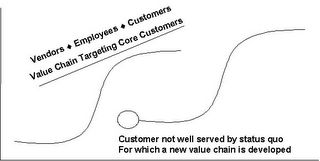
Markets are dynamic, and as they mature, some customers are not well served by the status quo. In some cases, an entrepreneur will identify how to deliver s simpler, cheaper, more convenient solution to these customers that creates a new, growing market. In some cases this new value proposition is so powerful that eventually it overthrows the original value chain. Think of Wal-Mart overthrowing Sears, and the PC overthrowing mainstream computers.
I have been involved in lots of companies an advisor, manager, and investor. I have been on both sides of this phenomenon, in the market leader that was being challenged and in the emerging company that was doing the attacking. Often the cost structure of the market leader makes it extremely difficult to serve these now customers with a cheaper, simpler, more convenient solution and still make money.
As the challenger becomes more successful and inflicts pain on the leader, people inside the leader become anxious and disparaging about this new emerging threat. You hear that these new customers just don't get it. They are unsophisticated. That the new upstarts are screwing up the market. That they are cockroaches. The customer is to blame for the problems the leader is experiencing.
Then you hear that the company just needs to work harder. Let’s get back to basics and focus on our fundamentals. Six sigma and other testing regimes are installed. But these leading companies will never succeed in this new market, no matter how hard they work or what they measure, unless and until they develop a new value that can be effectively delivered to these new customers.
I have come to believe that a similar phenomenon occurs in public education. The paradigm of the existing system is that schools will have considerable assistance from well educated parents in helping students with homework and studying at home. In South Carolina, half of students will not graduate from high school on time. If your family does not meet the educated, middle class paradigm the school was set up to serve, you tend to fail.
What is the answer from the public schools? Not that their paradigm does not serve students well who are not from educated, middle class families. Large organizations rarely admit that is the problem, rather they blame the customers. The parents of these children are to blame, because they are not involved with their kids in the way the schools are designed to work. Schools just throw up their hands in resignation; we can not meet the needs of these students because the parents don't get it.
What is the real problem? Just like Sears did not know how to serve customers in Bentonville, AK, existing public schools do not know how to reach students not well served by the status quo. This is where entrepreneurs are the most valuable in our society, creating new value to serve emerging markets of customers not well served by the status quo.
We desperately need school choice to unleash the power of entrepreneurs to meet the needs students failing in the current system. The entrepreneurial process is very difficult, with lots of starts and stops before someone finally gets it right. It is unrealistic that a system tuned to serving educated, middle class families is ever going to meet the needs of underserved students on its own, no matter how much money we spend or how much measurement we do.
When we place our bets, which we do every day with our tax dollars, let's bet on the educational entrepreneurs.

Markets are dynamic, and as they mature, some customers are not well served by the status quo. In some cases, an entrepreneur will identify how to deliver s simpler, cheaper, more convenient solution to these customers that creates a new, growing market. In some cases this new value proposition is so powerful that eventually it overthrows the original value chain. Think of Wal-Mart overthrowing Sears, and the PC overthrowing mainstream computers.
I have been involved in lots of companies an advisor, manager, and investor. I have been on both sides of this phenomenon, in the market leader that was being challenged and in the emerging company that was doing the attacking. Often the cost structure of the market leader makes it extremely difficult to serve these now customers with a cheaper, simpler, more convenient solution and still make money.
As the challenger becomes more successful and inflicts pain on the leader, people inside the leader become anxious and disparaging about this new emerging threat. You hear that these new customers just don't get it. They are unsophisticated. That the new upstarts are screwing up the market. That they are cockroaches. The customer is to blame for the problems the leader is experiencing.
Then you hear that the company just needs to work harder. Let’s get back to basics and focus on our fundamentals. Six sigma and other testing regimes are installed. But these leading companies will never succeed in this new market, no matter how hard they work or what they measure, unless and until they develop a new value that can be effectively delivered to these new customers.
I have come to believe that a similar phenomenon occurs in public education. The paradigm of the existing system is that schools will have considerable assistance from well educated parents in helping students with homework and studying at home. In South Carolina, half of students will not graduate from high school on time. If your family does not meet the educated, middle class paradigm the school was set up to serve, you tend to fail.
What is the answer from the public schools? Not that their paradigm does not serve students well who are not from educated, middle class families. Large organizations rarely admit that is the problem, rather they blame the customers. The parents of these children are to blame, because they are not involved with their kids in the way the schools are designed to work. Schools just throw up their hands in resignation; we can not meet the needs of these students because the parents don't get it.
What is the real problem? Just like Sears did not know how to serve customers in Bentonville, AK, existing public schools do not know how to reach students not well served by the status quo. This is where entrepreneurs are the most valuable in our society, creating new value to serve emerging markets of customers not well served by the status quo.
We desperately need school choice to unleash the power of entrepreneurs to meet the needs students failing in the current system. The entrepreneurial process is very difficult, with lots of starts and stops before someone finally gets it right. It is unrealistic that a system tuned to serving educated, middle class families is ever going to meet the needs of underserved students on its own, no matter how much money we spend or how much measurement we do.
When we place our bets, which we do every day with our tax dollars, let's bet on the educational entrepreneurs.
Saturday, May 07, 2005
George Fletcher to Lead SC Council on Competitiveness
Thursday, a friend of mine, George Fletcher, was elected Executive Director of the SC Council on Competitiveness. I think this is very encouraging and the shot in the arm that the Council needs to deliver on its potential.
George is a doer. In 2001, Clemson President Jim Barker called a meeting to discuss what we would do different if Clemson were located in Greenville. George asked to organize a committee to study having more Clemson research in Greenville. I participated on that committee, and we met for about a year. Ultimately the conversation led to what became the Clemson University Center for International Research. With partners Clemson, BMW, Michelin, IBM, and Microsoft, and a total of $112 million committed to date, this is the most important knowledge-based initiative in South Carolina today.
George also was the heart and soul behind the recent Greenville Vision 2025 process. This was an enormous effort to get many different organizations in Greenville together to begin to form a common vision of the community we want to create over the next couple of decades.
Neither CU-ICAR or Greenville Vision 2025 would exist today without the leadership of George Fletcher. The SC Council on Competitiveness could not have chosen better.
George is a doer. In 2001, Clemson President Jim Barker called a meeting to discuss what we would do different if Clemson were located in Greenville. George asked to organize a committee to study having more Clemson research in Greenville. I participated on that committee, and we met for about a year. Ultimately the conversation led to what became the Clemson University Center for International Research. With partners Clemson, BMW, Michelin, IBM, and Microsoft, and a total of $112 million committed to date, this is the most important knowledge-based initiative in South Carolina today.
George also was the heart and soul behind the recent Greenville Vision 2025 process. This was an enormous effort to get many different organizations in Greenville together to begin to form a common vision of the community we want to create over the next couple of decades.
Neither CU-ICAR or Greenville Vision 2025 would exist today without the leadership of George Fletcher. The SC Council on Competitiveness could not have chosen better.
InnoVenture MicroBusiness
Over the past year, I have had numerous conversations about how to have more diverse participation in business organizations I am a part of, from InnoVenture to the Chamber. One of the recurring issues that comes up over and over is that most African-American and Hispanic businesses are micro-businesses, with four or fewer employees. Often the owner can not afford the time away from the company, or the financial cost of participation is too high, for an activity that is not directly relevant for their business today.
I have come to believe it is important to focus on the needs of micri-businesses, in order to prime the pipeline of the growing businesses of tomorrow, especially in the African-American and Hispanic communities. So if I can find a Chairman and Executive Committee willing to organize the event, I am interested in having an annual InnoVenture MicroBusiness Conference.
If you are interested in participating, please let me know.
I have come to believe it is important to focus on the needs of micri-businesses, in order to prime the pipeline of the growing businesses of tomorrow, especially in the African-American and Hispanic communities. So if I can find a Chairman and Executive Committee willing to organize the event, I am interested in having an annual InnoVenture MicroBusiness Conference.
If you are interested in participating, please let me know.
Sunday, April 24, 2005
What did you think about InnoVenture 2005?
If you participated in InnoVenture 2005, please leave a comment about what you thought of the event.
Thursday, April 21, 2005
Leave a comment about what Swamp Fox should address?
We are currently planning to reposition this summer the Swamp Fox: News of the Knowledge Economy in SC web site, as well as this blog. We are interested in what you are most interested in. In particular, we'd like to stimulate some interactive discussion among our readers.
So, please take the time to leave a comment about topics you think are important?
Your input will be very helpful in producing the most useful and interesting Swamp Fox site for you.
So, please take the time to leave a comment about topics you think are important?
Your input will be very helpful in producing the most useful and interesting Swamp Fox site for you.
Sunday, April 17, 2005
Why don't we have an InnoVenture for Primary Education?
When I started InnoVenture, one of the challenges I saw in South Carolina is that many of the most talented people here work for large companies and do not have an infrastructure on which to spin out and start high-impact companies. Most entrepreneurs here have never met a venture capitalist or even really know what venture capital is. So as InnoVenture gets investors to Greenville, it encourages entrepreneurs to build relationships with those that can help them get new companies off the ground. Over time this should stimulate the number of wealth creating, high-impact companies we have here.
Even before InnoVenture, someone in a large company who has a idea for a new product their company does not want to pursue can leave and start a new company. If the entrepreneur can find customers to buy the new product, then the new company attracts more resources and gets to serve more customers.
Most school teachers work for a large organization too. But an entrepreneurial teacher who has a great idea for serving students not well served by the status quo does not have the same opportunity as someone in business, because the students she is targeting have no way of diverting the resources spent on their behalf to the entrepreneurial teacher.
Usually the school choice debate gets bogged down in funding, and too often it seems like an attack on public school teachers. They are as much as victim of the system as parents and students are. So why don't we turn the debate on its head and make heros out of entrepreneurial teachers with innovative ideas about how to better educate students not well served by the status quo. Let's have an InnoVenture for Primary Education in the fall.
By encouraging entrepreneurial teachers that there are community leaders willing to step up and support them, some of these teachers will be willing to step out just like entrepreneurs in big companies do. Once we identify a deal flow of outstanding education talent and ideas, then we can work on how we get them funded.
Anyone interested in working with me to put together InnoVenture for Primary Education? Contact me if you are.
Even before InnoVenture, someone in a large company who has a idea for a new product their company does not want to pursue can leave and start a new company. If the entrepreneur can find customers to buy the new product, then the new company attracts more resources and gets to serve more customers.
Most school teachers work for a large organization too. But an entrepreneurial teacher who has a great idea for serving students not well served by the status quo does not have the same opportunity as someone in business, because the students she is targeting have no way of diverting the resources spent on their behalf to the entrepreneurial teacher.
Usually the school choice debate gets bogged down in funding, and too often it seems like an attack on public school teachers. They are as much as victim of the system as parents and students are. So why don't we turn the debate on its head and make heros out of entrepreneurial teachers with innovative ideas about how to better educate students not well served by the status quo. Let's have an InnoVenture for Primary Education in the fall.
By encouraging entrepreneurial teachers that there are community leaders willing to step up and support them, some of these teachers will be willing to step out just like entrepreneurs in big companies do. Once we identify a deal flow of outstanding education talent and ideas, then we can work on how we get them funded.
Anyone interested in working with me to put together InnoVenture for Primary Education? Contact me if you are.
Wednesday, April 13, 2005
More thoughts about InnoVenture: A change in values?
As mentioned in the previous post, InnoVenture 2005 was a smashing success. Mary Ann Pires wrote an interesting editorial about InnoVenture 2005 in the Greenville News, which spurred a few thoughts of my own.
Mary made the observation, "the state's "progressives" ... [must] get finally together and affect the values change necessary to dominate more regressive elements."
We do need to create a deeper culture of innovation here, which pervades the community, from businesses to universities to government to public education. There are some who will have to be dragged along kicking and screaming.
I'm not sure what "regressive elements" are, but a big challenge is people and institutions that benefit from the status quo either seeing it in their interest to change or facing some outside pressure that forces them to change. Typically people and organizations do not change until they have to.
This is the most important reason we need to foster an environment where entrepreneurs can create new institutions targeting people not well served by the status quo, whether this is emerging high impact companies or charter schools. I am very encouraged by the blooming of innovation that is occurring all over the state.
As Michael Porter says, this is a marathon, not a sprint. We're making progress.
Something I feel very strongly about is that, while we need to study best practices in more highly innovative communities, we have to create a culture of innovation that fits the character and values of our community, not San Francisco or Austin or anywhere else. We will fail it we try to be a clone of somewhere else. We have to be globally distinctive.
Mary made the observation, "the state's "progressives" ... [must] get finally together and affect the values change necessary to dominate more regressive elements."
We do need to create a deeper culture of innovation here, which pervades the community, from businesses to universities to government to public education. There are some who will have to be dragged along kicking and screaming.
I'm not sure what "regressive elements" are, but a big challenge is people and institutions that benefit from the status quo either seeing it in their interest to change or facing some outside pressure that forces them to change. Typically people and organizations do not change until they have to.
This is the most important reason we need to foster an environment where entrepreneurs can create new institutions targeting people not well served by the status quo, whether this is emerging high impact companies or charter schools. I am very encouraged by the blooming of innovation that is occurring all over the state.
As Michael Porter says, this is a marathon, not a sprint. We're making progress.
Something I feel very strongly about is that, while we need to study best practices in more highly innovative communities, we have to create a culture of innovation that fits the character and values of our community, not San Francisco or Austin or anywhere else. We will fail it we try to be a clone of somewhere else. We have to be globally distinctive.
Thoughts about InnoVenture: A bad day for Luddites
InnoVenture 2005 was a smashing success. The energy in the room was electric. But then I am biased.
It is always good when others who are more objective comment on your work. Mary Ann Pires wrote an interesting editorial about InnoVenture 2005 in the Greenville News. Her comments are very complementary about InnoVenture, for which I am very grateful. Her thoughts did spur a few thoughts of my own.
Mary observed that InnoVenture was "A Bad Day for the Luddites." The historical Luddites were not wrong to be very concerned about the Industrial Revolution. There are winners and there are losers when economies shift, and the Luddites knew that they would be losers and fought hard to resist it. Who can blame them?
If you are a 55 year old textile worker with a high school degree, today's Luddite, you have a real problem and what is occurring is very scary. Going to Greenville Tech and training to become a nurse practitioner is probably not a real appealing option.
It is easy to say that the economy as a whole will benefit from change, especially if you personally expect to benefit from that change, but one of the real challenges we have to acknowledge and deal with is the transition for people that otherwise will get run over. One of the main issues that derails the discussion of having more innovation in public education, for example, is the challenge of those least likely to benefit, who are likely those who are already the least fortunate. We will not make progress as a community unless we find ways that no one gets left behind.
It is always good when others who are more objective comment on your work. Mary Ann Pires wrote an interesting editorial about InnoVenture 2005 in the Greenville News. Her comments are very complementary about InnoVenture, for which I am very grateful. Her thoughts did spur a few thoughts of my own.
Mary observed that InnoVenture was "A Bad Day for the Luddites." The historical Luddites were not wrong to be very concerned about the Industrial Revolution. There are winners and there are losers when economies shift, and the Luddites knew that they would be losers and fought hard to resist it. Who can blame them?
If you are a 55 year old textile worker with a high school degree, today's Luddite, you have a real problem and what is occurring is very scary. Going to Greenville Tech and training to become a nurse practitioner is probably not a real appealing option.
It is easy to say that the economy as a whole will benefit from change, especially if you personally expect to benefit from that change, but one of the real challenges we have to acknowledge and deal with is the transition for people that otherwise will get run over. One of the main issues that derails the discussion of having more innovation in public education, for example, is the challenge of those least likely to benefit, who are likely those who are already the least fortunate. We will not make progress as a community unless we find ways that no one gets left behind.
Sunday, April 10, 2005
Bill Gates says American high schools are obsolete and system fundamentally flawed
The following is from a speech Bill Gates gave to the National Education Summit on High Schools.
America's high schools are obsolete.
By obsolete, I don't just mean that our high schools are broken, flawed, and under-funded - though a case could be made for every one of those points.
By obsolete, I mean that our high schools - even when they're working exactly as designed - cannot teach our kids what they need to know today.
Training the workforce of tomorrow with the high schools of today is like trying to teach kids about today's computers on a 50-year-old mainframe. It's the wrong tool for the times.
Our high schools were designed fifty years ago to meet the needs of another age. Until we design them to meet the needs of the 21st century, we will keep limiting - even ruining - the lives of millions of Americans every year.
Today, only one-third of our students graduate from high school ready for college, work, and citizenship.
The other two-thirds, most of them low-income and minority students, are tracked into courses that won't ever get them ready for college or prepare them for a family-wage job - no matter how well the students learn or the teachers teach.
This isn't an accident or a flaw in the system; it is the system.
Friday, April 08, 2005
Why didn't African-Americans show up?
InnoVenture 2005 was a smashing success. 450 people attended. Major organizations from Clemson to USC, from Savannah River National Lab to SPAWAR, from BMW to Michelin, had displays of their innovations. Fifteen emerging companies presented their business plans to investors. The energy in the room was electric.
When we began planning for InnoVenture 2005 last summer, we invited African-Americans to join our planning committee (though they later dropped off). We went on a black radio station, and reached out to the Upstate Urban League Young Professionals. We invited an African-American keynote speakers (well we really invited a Harvard MBA who is an expert in innovation who happens to be an African- American).
That is addition to all the other promotion we did. We had an intensive e-mail campaign. We wrote editorials. We advertised on Mike Switzer's South Carolina Business Review on SC Public Radio. We had several people interviewed by Mike.
18% of the population in Greenville County, and 30% of the population in South Carolina is black. So why were less that 1% of the 450 people who attended InnoVenture black?
We will not have the most innovative economy we can unless people who have diverse experiences and perspectives are at the table. So what can we do to attract more blacks, Hispanics, and other minorities to InnoVenture 2006?
I'm open to any and all suggestions.
When we began planning for InnoVenture 2005 last summer, we invited African-Americans to join our planning committee (though they later dropped off). We went on a black radio station, and reached out to the Upstate Urban League Young Professionals. We invited an African-American keynote speakers (well we really invited a Harvard MBA who is an expert in innovation who happens to be an African- American).
That is addition to all the other promotion we did. We had an intensive e-mail campaign. We wrote editorials. We advertised on Mike Switzer's South Carolina Business Review on SC Public Radio. We had several people interviewed by Mike.
18% of the population in Greenville County, and 30% of the population in South Carolina is black. So why were less that 1% of the 450 people who attended InnoVenture black?
We will not have the most innovative economy we can unless people who have diverse experiences and perspectives are at the table. So what can we do to attract more blacks, Hispanics, and other minorities to InnoVenture 2006?
I'm open to any and all suggestions.
Thursday, March 24, 2005
InnoVenture aims at global competitiveness
The following appeared as an editorial in the Greenville News
In the 15th century, the Medici banking family of Florence brought a diversity of original thinkers into contact with each other, triggering the Renaissance explosion in the arts, sciences, philosophy and commerce. In "The Medici Effect," Frans Johansson describes how similar bursts of creativity and innovations are found today at the intersections of organizations, disciplines and cultures.
Mr. Johansson will be the keynote dinner speaker at InnoVenture 2005, to be held April 6 at the Palmetto Expo Center. InnoVenture is an opportunity for executives, researchers, entrepreneurs and investors to build relationships with major organizations seeking technologies and resources to be more globally competitive and with emerging, high-impact companies attracting capital to grow.
The Upstate is blessed with major sources of innovation, from Clemson, Furman and Wofford to the Michelin Americas R&D Corporation, the Kemet Innovation Center and the Milliken Research Corporation. As significant as this is, with 4 million people, South Carolina is about the size of a large borough in New York City.
Why would global investors, who have their choice of the best opportunities anywhere in the world, choose to invest here? Clearly, we have to work together across the region in order to have a critical mass of best-in-the-world clusters to be noticed. Within driving distance of the Upstate are significant resources from USC, Georgia Tech and the national labs at Oak Ridge and Savannah River to venture capital in Atlanta, Columbia and Charlotte.
Our region is already experiencing a blooming of innovation at intersections like those Mr. Johansson describes. Michelin is embedding electronic sensors in tires to monitor air pressure, and Ahold is using the system to improve the performance of its truck fleet. Innovations like this are so significant that Michelin has endowed a chair in automotive electronics at the Clemson International Center of Automotive Research.
The core of ICAR itself is a great example of the potential at the intersection of the BMW IT Research Center and the Carroll A. Campbell Graduate Engineering Center. Tired of South Carolina apparel manufacturers being ignored by Wal-Mart and other large discount chains, Jack Stone has launched an exciting apparel cluster initiative to leverage the Internet to build a direct-to-the-consumer business model, selling clothes the way Dell sells computers and Amazon sells books.
In the InnoVenture Innovation Hall, major companies, research universities and government labs will describe what they do and identify the innovative technologies, specialized talent and financial resources that would enhance their level of innovation. Organizations that have agreed to participate include Michelin, ICAR, the Savannah River National Lab, USC, Clemson, UNC Charlotte, Western Carolina and the S.C. Research Authority. Others are agreeing to participate daily.
In the InnoVenture Presentation Hall, emerging, high-impact companies will present their business plans to venture capitalists and other investors seeking resources to grow. We have recently completed a process of soliciting business plans and will announce who the presenting companies will be shortly.
InnoVenture has four focus areas: advanced materials and nanotechnologies, automotive and transportation, fuel cells and next energy, and communications and information technologies. These are areas where there are people in South Carolina today who are among the best in the world at what they do, so they are areas of focus on which we can build globally competitive clusters.
Finally, we have invited firms to participate from the "Southeastern Innovation Corridor." From Research Triangle Park to Atlanta and Oak Ridge to Charleston, this region has 23 million people, 16 research universities, two national laboratories and a deep industrial base. It is larger in population than any state except California, smaller in geography than Texas and all within driving distance of South Carolina. Over time we hope to develop the reputation of the Southeastern Innovation Corridor as one of the most innovative and productive places in the world, with South Carolina located strategically at its center.
This is an audacious goal, but there is no reason we cannot realize it. Achieving it starts with having great attendance from diverse organizations seeking others they can work with in their mutual self-interest to be more innovative and productive. You can find additional information at http://www.innoventuresc.com/.
In the past few years, there has been a blooming of innovation all across South Carolina as a consensus has developed that we have to enhance our economy. What an exciting time to be alive.
In the 15th century, the Medici banking family of Florence brought a diversity of original thinkers into contact with each other, triggering the Renaissance explosion in the arts, sciences, philosophy and commerce. In "The Medici Effect," Frans Johansson describes how similar bursts of creativity and innovations are found today at the intersections of organizations, disciplines and cultures.
Mr. Johansson will be the keynote dinner speaker at InnoVenture 2005, to be held April 6 at the Palmetto Expo Center. InnoVenture is an opportunity for executives, researchers, entrepreneurs and investors to build relationships with major organizations seeking technologies and resources to be more globally competitive and with emerging, high-impact companies attracting capital to grow.
The Upstate is blessed with major sources of innovation, from Clemson, Furman and Wofford to the Michelin Americas R&D Corporation, the Kemet Innovation Center and the Milliken Research Corporation. As significant as this is, with 4 million people, South Carolina is about the size of a large borough in New York City.
Why would global investors, who have their choice of the best opportunities anywhere in the world, choose to invest here? Clearly, we have to work together across the region in order to have a critical mass of best-in-the-world clusters to be noticed. Within driving distance of the Upstate are significant resources from USC, Georgia Tech and the national labs at Oak Ridge and Savannah River to venture capital in Atlanta, Columbia and Charlotte.
Our region is already experiencing a blooming of innovation at intersections like those Mr. Johansson describes. Michelin is embedding electronic sensors in tires to monitor air pressure, and Ahold is using the system to improve the performance of its truck fleet. Innovations like this are so significant that Michelin has endowed a chair in automotive electronics at the Clemson International Center of Automotive Research.
The core of ICAR itself is a great example of the potential at the intersection of the BMW IT Research Center and the Carroll A. Campbell Graduate Engineering Center. Tired of South Carolina apparel manufacturers being ignored by Wal-Mart and other large discount chains, Jack Stone has launched an exciting apparel cluster initiative to leverage the Internet to build a direct-to-the-consumer business model, selling clothes the way Dell sells computers and Amazon sells books.
In the InnoVenture Innovation Hall, major companies, research universities and government labs will describe what they do and identify the innovative technologies, specialized talent and financial resources that would enhance their level of innovation. Organizations that have agreed to participate include Michelin, ICAR, the Savannah River National Lab, USC, Clemson, UNC Charlotte, Western Carolina and the S.C. Research Authority. Others are agreeing to participate daily.
In the InnoVenture Presentation Hall, emerging, high-impact companies will present their business plans to venture capitalists and other investors seeking resources to grow. We have recently completed a process of soliciting business plans and will announce who the presenting companies will be shortly.
InnoVenture has four focus areas: advanced materials and nanotechnologies, automotive and transportation, fuel cells and next energy, and communications and information technologies. These are areas where there are people in South Carolina today who are among the best in the world at what they do, so they are areas of focus on which we can build globally competitive clusters.
Finally, we have invited firms to participate from the "Southeastern Innovation Corridor." From Research Triangle Park to Atlanta and Oak Ridge to Charleston, this region has 23 million people, 16 research universities, two national laboratories and a deep industrial base. It is larger in population than any state except California, smaller in geography than Texas and all within driving distance of South Carolina. Over time we hope to develop the reputation of the Southeastern Innovation Corridor as one of the most innovative and productive places in the world, with South Carolina located strategically at its center.
This is an audacious goal, but there is no reason we cannot realize it. Achieving it starts with having great attendance from diverse organizations seeking others they can work with in their mutual self-interest to be more innovative and productive. You can find additional information at http://www.innoventuresc.com/.
In the past few years, there has been a blooming of innovation all across South Carolina as a consensus has developed that we have to enhance our economy. What an exciting time to be alive.
Wednesday, March 16, 2005
More on Innovation in Education
An African-American leader recently objected to a current school choice proposal because, "I'm bothered that the present initiative sounds chillingly like something from the sixties when South Carolina made it's last ditch effort to block school desegregation"
Clearly the concern about returning to an era of segregation in education is valid, and we must all work to prevent that. Diversity, in all its many dimensions, is a major strength we have on which we can build the states' future. High quality, universal education is an essential foundation for South Carolina to be globally competitive.
Per capita income in South Carolina is approximately 80 percent of the national average. At the Moore Business School Economic Summit in December 2003, Michael Porter emphatically made the point that this is not because South Carolina is more black or more rural than the national average, but it is true primarily because major industries in the most affluent metropolitan areas in this state are not as productive as their peers in other parts of the country. We can not hide behind demographics to explain why we are falling behind the rest of the country. In fact, the per capita income gap between South Carolina versus North Carolina and Georgia, which have similar demographics and histories, has actually grown over the last twenty years.
In a recent study, Andrew Coulsen makes an observation about education in South Carolina, which is similar to Michael Porter's observation about the rest of our economy.
The current way we are delivering public education in South Carolina is not producing acceptable results. Accountability alone is not the answer. Measuring a broken process only highlights that the system is broken and produces frustration and anger in those charged with delivering results who have little or no flexibility to change the process. Ask any principal or teacher, who are as much victims of our current system of delivering education in South Carolina as students and parents.
If we are going to substantially improve the quality of education delivered to all children in South Carolina, we have to fundamentally change the way education is delivered. The problems we face in the state are overwhelming for any one of us to address. We have to have a system where passionate principals and teachers can create innovative educational alternatives for focused groups of students, especially those not well served by the status quo, and parents have the ability and the capacity to choose among the best educational opportunities for their children.
There are many underprivileged children whose parents are unwilling or unable to help them succeed. I went to the Aspen Institute last week as a part of the Liberty Fellowship. There I met Jack Markel, who is Treasurer of the State of Delaware and a Democrat. He was telling me of schools in Delaware where underprivileged children go to school at 7:30 am, begin class at 8:00, get out at 3:00 pm, participate in organized athletics until 5:00, go home for dinner, return to school at 6:30 to do their home work until 8:00. Basically these kids are immersed in a culture of excellence with a high work ethic and high expectations. It reminded me of the immersion in a culture of excellence that you hear the Governor's School for the Arts and Humanities and the Governor's School for Math and Science talk about here.
Many children in successful families already live with drill sergeants like these - they're called Moms and Dads. The Delaware model will not be appropriate for all children and families in South Carolina. But it may be a great solution for many children not well served by the current system. It is one of many creative alternatives to the current way of delivering education that we must allow to be tested, and if successful to thrive, if we are going to deliver universal, high-quality education to all children in the state.
Clearly the concern about returning to an era of segregation in education is valid, and we must all work to prevent that. Diversity, in all its many dimensions, is a major strength we have on which we can build the states' future. High quality, universal education is an essential foundation for South Carolina to be globally competitive.
Per capita income in South Carolina is approximately 80 percent of the national average. At the Moore Business School Economic Summit in December 2003, Michael Porter emphatically made the point that this is not because South Carolina is more black or more rural than the national average, but it is true primarily because major industries in the most affluent metropolitan areas in this state are not as productive as their peers in other parts of the country. We can not hide behind demographics to explain why we are falling behind the rest of the country. In fact, the per capita income gap between South Carolina versus North Carolina and Georgia, which have similar demographics and histories, has actually grown over the last twenty years.
In a recent study, Andrew Coulsen makes an observation about education in South Carolina, which is similar to Michael Porter's observation about the rest of our economy.
While South Carolina blacks score 15 points below blacks nationwide on the SAT, South Carolina whites score 27 points behind whites nationally. South Carolina students from lower-middle-income families score 20 points behind their national counterparts. Students from the wealthiest families score 39 points behind their economic peers in other states. The better educated a South Carolina student's parents happen to be, the further that student scores behind students in other states whose parents are similarly educated.
These results are not due to a higher percentage of young people taking the SAT in South Carolina. After adjusting for South Carolina's unusually high dropout rate, it becomes apparent that SAT-takers in this state make up about the same share of their age cohort as they do in other states. (A higher percentage of South Carolina high school seniors do take the test, but a smaller percentage of South Carolina children make it to the end of high school. Averaged together, these two factors cancel each other out).
Though the black/white achievement gap is somewhat smaller in South Carolina than in other states, it is still large in absolute terms. What's more, the gap is generally smaller because whites in South Carolina perform worse, not because African Americans in South Carolina perform better.
The current way we are delivering public education in South Carolina is not producing acceptable results. Accountability alone is not the answer. Measuring a broken process only highlights that the system is broken and produces frustration and anger in those charged with delivering results who have little or no flexibility to change the process. Ask any principal or teacher, who are as much victims of our current system of delivering education in South Carolina as students and parents.
If we are going to substantially improve the quality of education delivered to all children in South Carolina, we have to fundamentally change the way education is delivered. The problems we face in the state are overwhelming for any one of us to address. We have to have a system where passionate principals and teachers can create innovative educational alternatives for focused groups of students, especially those not well served by the status quo, and parents have the ability and the capacity to choose among the best educational opportunities for their children.
There are many underprivileged children whose parents are unwilling or unable to help them succeed. I went to the Aspen Institute last week as a part of the Liberty Fellowship. There I met Jack Markel, who is Treasurer of the State of Delaware and a Democrat. He was telling me of schools in Delaware where underprivileged children go to school at 7:30 am, begin class at 8:00, get out at 3:00 pm, participate in organized athletics until 5:00, go home for dinner, return to school at 6:30 to do their home work until 8:00. Basically these kids are immersed in a culture of excellence with a high work ethic and high expectations. It reminded me of the immersion in a culture of excellence that you hear the Governor's School for the Arts and Humanities and the Governor's School for Math and Science talk about here.
Many children in successful families already live with drill sergeants like these - they're called Moms and Dads. The Delaware model will not be appropriate for all children and families in South Carolina. But it may be a great solution for many children not well served by the current system. It is one of many creative alternatives to the current way of delivering education that we must allow to be tested, and if successful to thrive, if we are going to deliver universal, high-quality education to all children in the state.
Tuesday, March 15, 2005
Notes from Aspen: The Fault Line of Freedom.
In a wonderful week of thought and reflection at the Aspen Institute, we explored community and culture. An observation was made, which I agree with, that we are in a post-modern period where we are searching for meaning. Below is the third of three specific fault lines that I personally feel as a part of my search.
The Fault Line of Freedom
The third fault line is freedom. Many of the battles of American history, from the Revolution, to the War Between the States, World War II, and the Civil Rights Movement, have been fought under the banner of “freedom.” Today, many that Martin Luther King, Jr. dreamed would be “free at last” are no longer certain that freedom is always progress, or even always possible.
George W. Bush is pursuing a foreign policy that bases our security on others living in freedom. It is not essential that they share the dominate religion that we do, but it is essential that they share a common democratic, capitalist culture. This is the process by which we tamed Japan and Germany after World War II, but its application today has deeply divided our nation.
Even in the United States itself, proposals to increase the freedom to choose, from public education to health care to social security, are challenged as unworkable solutions. The most frequent objection is that the poor and disenfranchised at the bottom of society who are not a part of the middle class culture do not have the capacity to participate in choices available to others. I was struck last week by a comment that, “the free market preys on the vulnerable.”
While the War on Poverty in the 1960s was defined by giving people fish to eat, my passion has been to create a community where more people are empowered to fish. I have found the cultural barriers for some underserved people in our community to be significant hurdles for them. This is why the idea that people are “carriers of culture” impacted me so significantly. Rather than me directly reaching communities with limited access, perhaps my efforts would be better served focusing on a few individual “carriers of culture,” who can learn the fishing trade and then return and teach their communities to fish.
The Fault Line of Freedom
The third fault line is freedom. Many of the battles of American history, from the Revolution, to the War Between the States, World War II, and the Civil Rights Movement, have been fought under the banner of “freedom.” Today, many that Martin Luther King, Jr. dreamed would be “free at last” are no longer certain that freedom is always progress, or even always possible.
George W. Bush is pursuing a foreign policy that bases our security on others living in freedom. It is not essential that they share the dominate religion that we do, but it is essential that they share a common democratic, capitalist culture. This is the process by which we tamed Japan and Germany after World War II, but its application today has deeply divided our nation.
Even in the United States itself, proposals to increase the freedom to choose, from public education to health care to social security, are challenged as unworkable solutions. The most frequent objection is that the poor and disenfranchised at the bottom of society who are not a part of the middle class culture do not have the capacity to participate in choices available to others. I was struck last week by a comment that, “the free market preys on the vulnerable.”
While the War on Poverty in the 1960s was defined by giving people fish to eat, my passion has been to create a community where more people are empowered to fish. I have found the cultural barriers for some underserved people in our community to be significant hurdles for them. This is why the idea that people are “carriers of culture” impacted me so significantly. Rather than me directly reaching communities with limited access, perhaps my efforts would be better served focusing on a few individual “carriers of culture,” who can learn the fishing trade and then return and teach their communities to fish.
Monday, March 14, 2005
Notes from Aspen: The Fault Line of Identity
In a wonderful week of thought and reflection at the Aspen Institute, we explored community and culture. An observation was made, which I agree with, that we are in a post-modern period where we are searching for meaning. Below is the second of three specific fault lines that I personally feel as a part of my search.
The Fault Line of Identity
The second fault line is identity. A sense of community is only possible where we have a common sense of identity. David Hume, Adam Smith and others in the Scottish Enlightenment described the emergence of a capitalistic middle class culture on the periphery of the empire, Scotland. One precipitating cause of the Revolution of 1776 was the growing consciousness of another people on the periphery of the empire as a new breed of "Americans" distinct from their British cousins. Benjamin Franklin, perhaps the first self-conscious "American," described the emergence of the "middling people," or what we today call the middle class. A common, albeit nascent, culture is why the sages of the Scottish Enlightenment resonated with the Founding Fathers.
But four score and seven years later, a top graduate of West Point, Robert E. Lee, decided that his loyalty as a citizen of the State of Virginia created a higher obligation than his loyalty as a citizen of the United States of America. Looking through our modern paradigm as American citizens, we can not conceive of making this choice today.
When I was in college, we studied "multinational corporations," which did business as distinct business units in different countries and cultures around the world. Today I work for KEMET Corporation, which consciously promotes itself as a "global company," with one corporate culture seamlessly doing business wherever facilities of global customers are located in the world.
Recently I founded InnoVenture, to develop a culture of innovation in a region we define as the "Southeastern Innovation Corridor," which is within roughly a four hour drive of Greenville but touches parts of five states. I have found this definition of our region enthusiastically supported by business people and academics who will benefit from its critical mass of talent and resources, but disorienting to politicians who feel confined by voting constituencies in political jurisdictions.
France, Germany, the United Kingdom and others are attempting to create a common identity as "Europeans." I often wonder if eighty-seven years from now, Tony Blair's perception of himself as "British" or George Bush's as an "American" will seem as quaint as Robert E. Lee’s perception of himself as a "Virginian." That was until September 11th brought home the brutal reality that "providing for the common defense’ was an essential mission of the government of the United States of America. Who we are and where our loyalties lay are as confusing today as they were to some in 1860.
The Fault Line of Identity
The second fault line is identity. A sense of community is only possible where we have a common sense of identity. David Hume, Adam Smith and others in the Scottish Enlightenment described the emergence of a capitalistic middle class culture on the periphery of the empire, Scotland. One precipitating cause of the Revolution of 1776 was the growing consciousness of another people on the periphery of the empire as a new breed of "Americans" distinct from their British cousins. Benjamin Franklin, perhaps the first self-conscious "American," described the emergence of the "middling people," or what we today call the middle class. A common, albeit nascent, culture is why the sages of the Scottish Enlightenment resonated with the Founding Fathers.
But four score and seven years later, a top graduate of West Point, Robert E. Lee, decided that his loyalty as a citizen of the State of Virginia created a higher obligation than his loyalty as a citizen of the United States of America. Looking through our modern paradigm as American citizens, we can not conceive of making this choice today.
When I was in college, we studied "multinational corporations," which did business as distinct business units in different countries and cultures around the world. Today I work for KEMET Corporation, which consciously promotes itself as a "global company," with one corporate culture seamlessly doing business wherever facilities of global customers are located in the world.
Recently I founded InnoVenture, to develop a culture of innovation in a region we define as the "Southeastern Innovation Corridor," which is within roughly a four hour drive of Greenville but touches parts of five states. I have found this definition of our region enthusiastically supported by business people and academics who will benefit from its critical mass of talent and resources, but disorienting to politicians who feel confined by voting constituencies in political jurisdictions.
France, Germany, the United Kingdom and others are attempting to create a common identity as "Europeans." I often wonder if eighty-seven years from now, Tony Blair's perception of himself as "British" or George Bush's as an "American" will seem as quaint as Robert E. Lee’s perception of himself as a "Virginian." That was until September 11th brought home the brutal reality that "providing for the common defense’ was an essential mission of the government of the United States of America. Who we are and where our loyalties lay are as confusing today as they were to some in 1860.
Saturday, March 12, 2005
Notes from Aspen: The Fault Line of Faith
In a wonderful week of thought and reflection at the Aspen Institute, we explored community and culture. An observation was made, which I agree with, that we are in a post-modern period where we are searching for meaning. Below is the first of three specific fault lines that I personally feel as a part of my search.
The Fault Line of Faith
The first fault line is faith. During the enlightenment, people began to abandon superstition as an explanation of the world around them, replacing it with reason. They gained confidence that the scientific method would ultimately reveal truth and the path to progress. We have entered an age when we are no longer comfortable that the scientific method will lead to the ultimate truth or that it will always lead to progress.
Nobel laureate Charles Townes (who we are proud is from Greenville, SC) recently won the Templeton Prize. Below is a Wall Street Journal editorial he wrote last week, discussing the contrast between science, which explores "what [our world] is and how it works," and faith, which seeks "the purpose of our universe and human life." Dr. Townes is one of a growing population, including me, that does not find belief in science and faith in God to be intellectually inconsistent.
John Paul II believes he shares Christ’s sufferings, first, by bearing the cross of communism as a young man, and now, by bearing the cross of Parkinson’s disease. The Pope’s acceptance of his burdens as gifts from God to enhance his spiritual growth, and the inspiration his witness provides billions of people worldwide, challenges the notions of "happiness" that we discussed last week.
While faith can be inspiring, we are threatened by various sects of religious fundamentalism around the world, each claiming to have a unique and exclusive revelation of truth. This certainty about things transcendent creates anxiety in the rest of us, and seems to create hostility in at least some of those who hold these views and feel threatened by a secular culture. The tension between perceptions of faith as a light for the world or an opiate of the masses underpins much of the cultural war occurring in the United States as well as around the world.
Our Special Universe
By CHARLES H. TOWNES March 11, 2005; Page A10, Wall Street Journal
What is the purpose or meaning of life? Or of our universe? These are questions which should concern us all.
As a scientist, I have been primarily trying to understand our world -- the universe, including humans -- what it is and how it works. As a religiously oriented person, I also try to understand the purpose of our universe and human life, a primary concern of religion. Of course, if the universe has a purpose, then its structure, and how it works, must reflect this purpose. This obvious relation brings science and religion together, and I believe the two are much closer and more similar in nature than is usually recognized.
My study of the connection between science and religion began when, back in the 1960s, the Men's Class of Riverside Church in New York asked me to talk as a scientist about my view of religion -- perhaps because I was the only scientist they knew who regularly attended church. The editor of IBM's THINK magazine happened to be in the audience and shortly afterwards telephoned to ask if, of all things, he could publish the talk in THINK. He did. I was again surprised when the editor of MIT's alumni journal asked if he could also publish it. The latter resulted in a serious objection on the part of an MIT alumnus, who would have nothing more to do with MIT if such were ever done again.
I certainly agree that university journals should not be used to sell religious views. On the other hand, I believe that serious intellectual discussion of the possible meaning of our universe, or the nature of religion and philosophical views of religion and science, need to be openly and carefully discussed. In the intellectual world, we shouldn't try to sell ideas, but we should be able to examine them freely.
A well-established scientist and philosopher was once asked to define the "scientific method." Oh, he said, it is "to work like the devil to find the answer, with no holds barred." I believe the same can be said of religion. We use all of our human resources to understand either one -- instincts, intuition, logic, evidence (experiences or observation), postulates or faith, and even revelations.
We all recognize that science has produced remarkable results. It allows us to do so many things and to think we already understand so much. Science is indeed wonderful, and yet there are still mysteries, puzzles and inconsistencies.
We are now convinced that the matter we can identify in our universe is only about 5% of all that is there. What is the rest of it? Scientists are trying hard to detect this strange unknown matter. Will they, and when? Relativity and quantum mechanics have been remarkably successful, and we believe they explain and teach us many things. And yet, in certain ways they seem logically inconsistent. At present, we simply accept such inconsistencies and use these two fields of science with pride and pleasure.
The mathematician Gödel noted that to prove something we must start with a set of postulates, but then demonstrated that we can never prove the set of postulates are even self-consistent unless we make a new overarching set of postulates which themselves cannot be proven self-consistent. So, in science, too, we need faith -- or what we normally call postulates. An extreme and somewhat amusing statement of our lack of firm proof was that of Bishop Berkeley, for whom my town of Berkeley, Calif., was named. He noted that we cannot absolutely prove that the people and things we think we see are really there -- we may not be seeing them at all but only have such things in our imagination. The bishop was perhaps correct, but nevertheless we all believe those people and things we see are real.
As we try hard to learn and understand more, where will that take us, and how much of our present sense of reality and meaning will be changed? I believe physics provides an illustration of the possible nature of future changes.
Classical, or Newtonian, physics has been remarkably successful, explaining and predicting many things very accurately and convincingly. But, as scientists began to look closely at very small things such as atoms and molecules, they were forced to modify their ideas basically, and "quantum mechanics" was discovered.
Quantum mechanics and classical mechanics are philosophically very different, and the behavior of atoms and molecules can only be understood by this radically different quantum mechanics. But quantum mechanics must and does also apply to larger objects such as planets, balls, or our own motions. Classical mechanics was in principle quite wrong. But, it was a good approximation, explaining very accurately the motions of everything much larger than atoms, such as planets, balls, or ourselves. We still teach and use classical mechanics. It's a very good approximation to reality and much simpler to understand than quantum mechanics, even though philosophically incorrect.
As we understand more, will our views in science and also in religion be revolutionized as science already has been by quantum mechanics? My guess is yes. We must be open-minded and without completely frozen ideas in either science or religion. But even with future changes, I also guess that, like classical mechanics, our present understanding may be a good and useful approximation even though new and deeper views may be revolutionary.
Overall, I believe we must try hard to understand both how our universe works and what is its meaning as well as we can, and for now, live by our best understanding. I hope very much that humans will in the future understand more and more deeply, which can change our views. And, just as classical mechanics still works well, I expect our present ideas and principles will still have a useful and functional validity.
Mr. Townes is a 1964 Nobel laureate in physics and inventor of the laser. On Wednesday, he was awarded the 2005 Templeton prize for his study of the relation between science and religion.
The Fault Line of Faith
The first fault line is faith. During the enlightenment, people began to abandon superstition as an explanation of the world around them, replacing it with reason. They gained confidence that the scientific method would ultimately reveal truth and the path to progress. We have entered an age when we are no longer comfortable that the scientific method will lead to the ultimate truth or that it will always lead to progress.
Nobel laureate Charles Townes (who we are proud is from Greenville, SC) recently won the Templeton Prize. Below is a Wall Street Journal editorial he wrote last week, discussing the contrast between science, which explores "what [our world] is and how it works," and faith, which seeks "the purpose of our universe and human life." Dr. Townes is one of a growing population, including me, that does not find belief in science and faith in God to be intellectually inconsistent.
John Paul II believes he shares Christ’s sufferings, first, by bearing the cross of communism as a young man, and now, by bearing the cross of Parkinson’s disease. The Pope’s acceptance of his burdens as gifts from God to enhance his spiritual growth, and the inspiration his witness provides billions of people worldwide, challenges the notions of "happiness" that we discussed last week.
While faith can be inspiring, we are threatened by various sects of religious fundamentalism around the world, each claiming to have a unique and exclusive revelation of truth. This certainty about things transcendent creates anxiety in the rest of us, and seems to create hostility in at least some of those who hold these views and feel threatened by a secular culture. The tension between perceptions of faith as a light for the world or an opiate of the masses underpins much of the cultural war occurring in the United States as well as around the world.
* * *
Our Special Universe
By CHARLES H. TOWNES March 11, 2005; Page A10, Wall Street Journal
What is the purpose or meaning of life? Or of our universe? These are questions which should concern us all.
As a scientist, I have been primarily trying to understand our world -- the universe, including humans -- what it is and how it works. As a religiously oriented person, I also try to understand the purpose of our universe and human life, a primary concern of religion. Of course, if the universe has a purpose, then its structure, and how it works, must reflect this purpose. This obvious relation brings science and religion together, and I believe the two are much closer and more similar in nature than is usually recognized.
My study of the connection between science and religion began when, back in the 1960s, the Men's Class of Riverside Church in New York asked me to talk as a scientist about my view of religion -- perhaps because I was the only scientist they knew who regularly attended church. The editor of IBM's THINK magazine happened to be in the audience and shortly afterwards telephoned to ask if, of all things, he could publish the talk in THINK. He did. I was again surprised when the editor of MIT's alumni journal asked if he could also publish it. The latter resulted in a serious objection on the part of an MIT alumnus, who would have nothing more to do with MIT if such were ever done again.
I certainly agree that university journals should not be used to sell religious views. On the other hand, I believe that serious intellectual discussion of the possible meaning of our universe, or the nature of religion and philosophical views of religion and science, need to be openly and carefully discussed. In the intellectual world, we shouldn't try to sell ideas, but we should be able to examine them freely.
A well-established scientist and philosopher was once asked to define the "scientific method." Oh, he said, it is "to work like the devil to find the answer, with no holds barred." I believe the same can be said of religion. We use all of our human resources to understand either one -- instincts, intuition, logic, evidence (experiences or observation), postulates or faith, and even revelations.
We all recognize that science has produced remarkable results. It allows us to do so many things and to think we already understand so much. Science is indeed wonderful, and yet there are still mysteries, puzzles and inconsistencies.
We are now convinced that the matter we can identify in our universe is only about 5% of all that is there. What is the rest of it? Scientists are trying hard to detect this strange unknown matter. Will they, and when? Relativity and quantum mechanics have been remarkably successful, and we believe they explain and teach us many things. And yet, in certain ways they seem logically inconsistent. At present, we simply accept such inconsistencies and use these two fields of science with pride and pleasure.
The mathematician Gödel noted that to prove something we must start with a set of postulates, but then demonstrated that we can never prove the set of postulates are even self-consistent unless we make a new overarching set of postulates which themselves cannot be proven self-consistent. So, in science, too, we need faith -- or what we normally call postulates. An extreme and somewhat amusing statement of our lack of firm proof was that of Bishop Berkeley, for whom my town of Berkeley, Calif., was named. He noted that we cannot absolutely prove that the people and things we think we see are really there -- we may not be seeing them at all but only have such things in our imagination. The bishop was perhaps correct, but nevertheless we all believe those people and things we see are real.
* * *
The most basic of sciences, which is physics, has been increasingly concentrating on problems which are pertinent to the interaction of our ideas in science and religion, such as the origins of the universe, cosmology, the nature of matter, and of the physical laws. This has recently focused attention on what a special universe is ours, and the strikingly special laws of science required for the existence of life. Why does such an improbable universe exist?As we try hard to learn and understand more, where will that take us, and how much of our present sense of reality and meaning will be changed? I believe physics provides an illustration of the possible nature of future changes.
Classical, or Newtonian, physics has been remarkably successful, explaining and predicting many things very accurately and convincingly. But, as scientists began to look closely at very small things such as atoms and molecules, they were forced to modify their ideas basically, and "quantum mechanics" was discovered.
Quantum mechanics and classical mechanics are philosophically very different, and the behavior of atoms and molecules can only be understood by this radically different quantum mechanics. But quantum mechanics must and does also apply to larger objects such as planets, balls, or our own motions. Classical mechanics was in principle quite wrong. But, it was a good approximation, explaining very accurately the motions of everything much larger than atoms, such as planets, balls, or ourselves. We still teach and use classical mechanics. It's a very good approximation to reality and much simpler to understand than quantum mechanics, even though philosophically incorrect.
As we understand more, will our views in science and also in religion be revolutionized as science already has been by quantum mechanics? My guess is yes. We must be open-minded and without completely frozen ideas in either science or religion. But even with future changes, I also guess that, like classical mechanics, our present understanding may be a good and useful approximation even though new and deeper views may be revolutionary.
Overall, I believe we must try hard to understand both how our universe works and what is its meaning as well as we can, and for now, live by our best understanding. I hope very much that humans will in the future understand more and more deeply, which can change our views. And, just as classical mechanics still works well, I expect our present ideas and principles will still have a useful and functional validity.
Mr. Townes is a 1964 Nobel laureate in physics and inventor of the laser. On Wednesday, he was awarded the 2005 Templeton prize for his study of the relation between science and religion.
Friday, March 11, 2005
Notes from Aspen - The One who endowed us with Liberty
All week we have struggled with the fact that we live in an increasingly global, diverse and changing world. Creating synergy with others requires finding a common mission and set of values that allows us to collaborate.
The seminar I am attending has very bright, accomplished people around the table, many of whom have no place for faith in their lives. Throughout the week, I expressed the concern that it is not possible to find a universal set of human values solely from within ourselves, because that ultimately leads to narcissism. We love because we first were loved, and the value of individuals is derived from the reality that we are all children of God.
Vaclav Havel, former President of the Czech Republic, provided an appropriate admonition to end the week:
"The Declaration of Independence, adopted 218 years ago ..., states that the Creator gave man the right to liberty. It seems man can realize that liberty only if he does not forget the One who endowed him with it."
The seminar I am attending has very bright, accomplished people around the table, many of whom have no place for faith in their lives. Throughout the week, I expressed the concern that it is not possible to find a universal set of human values solely from within ourselves, because that ultimately leads to narcissism. We love because we first were loved, and the value of individuals is derived from the reality that we are all children of God.
Vaclav Havel, former President of the Czech Republic, provided an appropriate admonition to end the week:
"The Declaration of Independence, adopted 218 years ago ..., states that the Creator gave man the right to liberty. It seems man can realize that liberty only if he does not forget the One who endowed him with it."
Wednesday, March 09, 2005
Notes from Aspen - Carriers of culture
We are all carriers of our culture - whether we want to be or not. We carry inside us the cumulative experiences of our ancestors and ourselves, the present reality in which we live, and the hopes for the future.
Each of us carrys a different culture. With those close to us in family, time, or place, we share many aspects of a common culture. With others, we have a widely different culture.
If we can manage this diversity effectively, taking the best that each individual brings, the result can be better than any of us can realize individually. But diversity can also lead to conflict, when our cultural differences are so varied that they seem in opposition to one another.
It is not realistic that we will not make judgments about others. That is a part of our human nature. Making prudent judgments of the world around us is essential to success. But by us having the privilege of judging others, they have the privilege of judging us as well.
At one point during the day, we were reading a play about the Nigerian Yorubian culture. The moderator asked if the Yorubian culture was Aristotelian (as in an aristocratic society described by Aristotle). Someone in the group responded that an equally valid question, and perhaps a more enlightening question, might be is Aristotelian culture Yorubian. Putting on the other person’s shoes is the first step to finding the common ground where we can benefit each other.
Each of us carrys a different culture. With those close to us in family, time, or place, we share many aspects of a common culture. With others, we have a widely different culture.
If we can manage this diversity effectively, taking the best that each individual brings, the result can be better than any of us can realize individually. But diversity can also lead to conflict, when our cultural differences are so varied that they seem in opposition to one another.
It is not realistic that we will not make judgments about others. That is a part of our human nature. Making prudent judgments of the world around us is essential to success. But by us having the privilege of judging others, they have the privilege of judging us as well.
At one point during the day, we were reading a play about the Nigerian Yorubian culture. The moderator asked if the Yorubian culture was Aristotelian (as in an aristocratic society described by Aristotle). Someone in the group responded that an equally valid question, and perhaps a more enlightening question, might be is Aristotelian culture Yorubian. Putting on the other person’s shoes is the first step to finding the common ground where we can benefit each other.
Monday, March 07, 2005
Notes from Aspen - Humans are social beings
I sit here on a beautiful day in Aspen, CO – bright sunshine, snow covered mountains, and brisk clean air – participating in a seminar at the Aspen Institute as a part of the Liberty Fellowship.
For a couple of days the conversations have been how communities form and what benefits they provide to individuals. We have looked at ancient sages, from Plato to Confucius, to more modern writers, such as John Stuart Mill and Milton Freeman.
One idea they all have in common is humans are social beings. Communities help individuals realize their full potential, while restraining our worst instincts.
My overriding thoughts have been how all this applies back home to our efforts to form a more innovative and productive community that can be globally competitive. At the end of the day, people will protect their own self-interest, but people can be inspired to work together in their mutual self-interest to accomplish great things that are bigger than individuals.
I looking forward to getting home and putting into practice concepts that have proven the test of time.
For a couple of days the conversations have been how communities form and what benefits they provide to individuals. We have looked at ancient sages, from Plato to Confucius, to more modern writers, such as John Stuart Mill and Milton Freeman.
One idea they all have in common is humans are social beings. Communities help individuals realize their full potential, while restraining our worst instincts.
My overriding thoughts have been how all this applies back home to our efforts to form a more innovative and productive community that can be globally competitive. At the end of the day, people will protect their own self-interest, but people can be inspired to work together in their mutual self-interest to accomplish great things that are bigger than individuals.
I looking forward to getting home and putting into practice concepts that have proven the test of time.
Subscribe to:
Posts (Atom)