First, before someone responds about this being overly political or an an attack on public education, take a deep breath ... it's neither. It's about how important it is to create a culture of innovation in education.
Brad Warthen, editorialist for The State, keeps a blog which I enjoy reading. We've had a conversation back and forth about a recent entry, "Inez shocker!", about her tenure as Secretary of Education in South Carolina.
Inez said she would not run for a third term, but would remain involved in "changing the culture of education in South Carolina, so people not only respect it but revere it."
To which I answered, "If Inez would focus her efforts on improving the culture inside public education so that it becomes a much more innovative system that develops creative solutions to meet the needs of children not well served today, then she would be doing a real service to the state."
Brad responded, "Mrs. Tenenbaum DID and CONTINUES to "focus her efforts on improving the culture inside public education so that it becomes a much more innovative system that develops creative solutions to meet the needs of children not well served today." That's why the public schools have improved steadily under her tenure, according to most objective measurements." Then Brad goes on, "And she's done it with grace in the face of constant partisan pettiness and outright malicious lies that have deliberately undermined public confidence in the fine job that teachers, administrators, students and parents have done in moving public education forward in South Carolina."
Sigh deeply. This unfortunately is the way this debate usually goes about how to improve public education goes. Our kids lose when little progress is made on reaching a consensus about fundamental changes necesary to improve the system of delivering education in the state.
Inez deserves credit for making the most of the existing system of delivering education. Test scores have improved in recent years as a result, and that is a very good thing. But she did very little to help create a culture of innovation inside public education, in fact she strongly resisted change along with the rest of the education establishment.
There is a wide spectrum of ways in which students think and learn. And there is a wide spectrum of circumstances from which children come. For some percentage of children, the way we deliver public education today matches up well with how they learn and the support they receive at home. Most of these children do well, and some even excel. But a very large percentage of children are not served well by the current system, and they are failing. The price we all pay for this is very high.
We need to find a way to give the best and brightest entrepreneurial teachers a way of creating now models for delivering education to students not well served today. Charter schools are a weak form of this, innovation lite. Some of the most innovative models may look very different from the way we deliver education today, and would never see the light of day if they had to take root inside or be approved by the existing system. This is not because anyone in education is bad, necessarily, if it just the way large organizations work. There is powerful momentum inside large organizations, be they companies or governments, to maintain the status quo and resist change. Harvard Professor Clayton Christensen wrote a very insightful book describing this, called The Innovator’s Dilemma. I also address this in my book, Swamp Fox Insights.
We can continue to make incremental improvements in education continuing on the path we are on. But we can’t make quantum leaps in improving education unless we create a system that allows entrepreneurial educators tp bring new ideas to underserved students. That’s going to take a strong political leader, like a Dick Riley, who can lead us to a much better place in education than we are today.
Friday, August 26, 2005


Sunday, August 21, 2005
Something is stirring: we're at an inflection point
In the late 1990s, I began to sense that South Carolina was at an inflection point - needing to do different if we were going to continue to be globally competitive. The economic development model of branch manufacturing was running out of stream.
In 2000, I traveled across the state to talk with leaders about the need for a more innovative economy. I talked with Governor Hodges and ex-Governors, with CEOs, university leaders, economic developers, and newspaper editors.
Something was stirring. Shortly thereafter, Jim Barker called a meeting and asked if Clemson were in Greenville how our relationship would be different. George Fletcher continued the conversation, and ultimately the Clemson International Center for Automotive Research was born. Sam Tenenbaum was an early advocate of endowed research chairs, and Governor Hodges sent a small group of people, including me, to Austin to study their model. The SC Centers of Economic Excellence Act occurred shortly thereafter. Darla Moore, who had given tens of millions to the USC Moore Business School, created the Palmetto Institute to begin creating a strategic plan for the state. They engaged Michael Porter, whose advice to develop industry clusters has become orthodoxy. I began Swamp Fox and a series of conferences leading to InnoVenture which were grassroots efforts to build relationships among innovators and entrepreneurs.
We've seen some early experiments go away. The Upstate Coalition for Entrepreneurial Development recently declared victory in seeding several entrepreneurial activities and went out of business. A few other initiatives across the state, like the Supply Chain Coalition, have more quietly faded away.
But boom! Over the past four years, there has been a blooming of innovation in the state.
The early initiatives that gained traction are building momentum. SC BIO, the SC Centers of Excellence Review Board, and the USC Columbia Technology Incubator all report business is booming. The USC research campus is becoming a reality. The SC Health Sciences Initiative has built a coalition among USC, MUSC, Greenville Hospital and Palmetto Health Care. The SC Next Energy Initiative has been barnstorming the state. And InnoVenture has gained traction with major constituents who have gained a sense of ownership in the process.
Now something else is stirring. We’ve reached another inflection point. People across the state and across these initiatives are asking a similar question: how do we convert this activity into wealth creation in South Carolina. The Greenville Chamber is going on an intercity visit to Austin, TX, which in the late 1980s they had a supernova explosion – Dell Computer. When a company in your area creates several billion dollars in market value, and sprinkles some of that back into the local community into the next generation of companies, into the United Way and other community organizations, it alters the landscape of the community forever.
So how do we do that? Seed our Dell Computer that creates enormous wealth here. That is becoming a major focus here as we move forward.
Wednesday, August 17, 2005
InnoVenture's top-of-mind-position: Growth and Wealth Creation
Geoffrey A. Moore in Crossing the Chasm states that in marketing "there is one fundamental key to success: ...to create a space inside the customer's head called 'best buy for this type of situation' and to attain sole, undisputed occupancy of that space."
Clayton Christensen in The Innovator's Solution observes, "companies that target their products at the circumstances in which customers find themselves, rather than the customers themselves, are those that can launch predictably successful products. Put another way, the crucial unit of analysis is the circumstance and not the customer." He goes on, "A jobs-to-be-done lens can help innovators come to market with an initial product that is much closer to what customers will discover that they value. The way to get as close as possible to this target is to develop hypotheses by carefully observing what people seem to be trying to achieve for themselves," but are finding difficult, expensive, or inconvenient to do.
Hmmmm. So apply that to InnoVenture. Our target market is "innovators and entrepreneurs." What are they trying to achieve for themselves, that they are finding difficult, expensive or inconvenient to do.
Some innovators inside big organizations are trying to commercialize discontinuous innovations. Why would Michelin put any focus on the Tweel, when it is easier in the short term to sell more radial tires?
Entrepreneurs leading high-impact companies are also trying to gain traction commercializing discontinuous innovations. Certainly it would be much easier to have a real job with a stable salary and benefits. Why do entrepreneurs do it?
Innovators and entrepreneurs are driven to create growth and wealth. Michelin can make money on radial tires today, but the company can not meet its growth objectives with mature products. Entrepreneurs can't get rich working for someone else.
Innovators and entrepreneurs find their quest for growth and wealth creation really, really hard, so they begin to look for relationships, expertise, and resources that can help them. That is a job they that they will look to InnoVenture to do for them.
Friday, August 12, 2005
My book's on Amazon.com!
Swamp Fox Insights: Innovation and Entrepreneurship in a Time of Profound Change is now available at Amazon.com.
I've long respected the power of Amazon, but now I've realized the true impact in a personal way.
BookSurge in Charleston prints copies of the book on demand as orders are placed, so no huge investment in inventory is necessary. People anywhere in the world are a market for the book. A friend that lives life between New York and Japan bought the first copy online.
The fact that almost no one knows the book exists is another problem, but the distribution channel is in place. I've sold three books so far. Give me a call, and I'll buy lunch with the royalties :)
This isn't a path to riches, but it is still very awesome.
The explosive potential of broadband
The Greenville Chamber held a meeting Friday to discuss "Economic Development Issues Related To Broadband Communications."
The conversation began around the infrastructure that was in place - the amount, kind, and speed of broadband access that we had in the region. We realized that we had a strong broadband infrastructure, probably more than was generally understood and definitely more than was promoted.
The conversation turned to how broadband was being used to outsource work to India. One participant related how his wife, a solo architect, sought out draftsmen online that could convert her concepts into plans, so she could focus on the higher value added activity of bringing her clients' ideas to life in exciting architectural designs.
A Google search found draftsmen she could work with in Easley, SC and Bangalore, India. She contacted the draftsmen in Easley, who said she could submit her drawings online and could get something back in about a week. The Indian firm had several degreed engineers and said that she could submit her concepts in the evening and have drawings in her email in the morning. The Easley draftsmen don’t realize that the world has changed and the competition is not down the street but around the world. And we never even got to cost. In Thomas Friedman’s new vernacular, the folks in Easley don’t realize that The World is Flat.
Then the conversations turned again to the fact that the world is flat – in both directions. Broadband has opened up India as a market for us as much as us a market for them. Bits flow as easily from us to them as from them to us.
We need to explore the opportunities of this. We are at the beginning of a period where new, powerful business models are being created that leverage the powerful new communications technologies - eBay, and Amazon, and Dell Computer. Someone in the chamber discussion talked about his translation business which he runs from Greenville serving customers around the world. We challenged ourselves to begin to think about the opportunities that broadband creates to do business in expanded markets around the world.
The most encouraging part of the meeting is that when I left a small group of people had already gathered and were already starting to talk about what the next steps should be. Take an inventory of the broadband assets we have. Work this into the promotional materials for Greenville. Organize a forum to discuss the opportunities that exist …
This is what I really love about Greenville.
All of this is self-serving, John
It's great to have friends that respect you enough to give you feedback on how the world perceives your work, both the good and the bad.
I stopped by to visit with a marketing guru friend to discuss business opportunities around Swamp Fox, InnoVenture and related activities of mine. The most recent iteration of my journey started in 2000, when I realized that knowledge professionals in our region did not know one another. Swamp Fox: News of the Southeastern Innovation Corridor is a weekly email update to create awareness of innovations in the region. InnoVenture is an annual conference, along with forums throughout the year, to build relationships among knowledge professionals in companies, universities, tech colleges, high-impact companies, and support organizations. The Swamp Fox/InnoVenture database now has 6000 innovators and entrepreneurs.
My friend said I had a lot of fans across the state, especially for my persistence and tenacity over the years. That’s flattering. Some, though, get tired of the message, she said. After four years it is a challenge to keep the message fresh, as all preachers know. “Other people,” she said “think all of this is self-serving, John.”
The first meeting that led up to where we are was held in early 2001. I began that meeting, and I have included in many other meetings, a favorite Adam Smith quote, "It is not from the benevolence of the butcher, the brewer, or the baker that we expect our dinner, but from their regard to their own interest."
We all participate in community activities out of our enlightened self-interest. If we will all get our self-interest out on the table, if you understand why I am here and I understand why you are here, then we can find the common ground where we can work together. Public goods will be created, but they are a byproduct of us working together in our enlightened, self-interest. If we pretend that we are all here only for the broader public good, then we just cloud the real reasons we're here and make it harder for us to work together effectively.
So to the charge, “All of this is self-serving, John,” I plead guilty. I’ve never been shy about explaining to anyone that asked what I expect to get out of this. In fact, I have been meeting with people across the state exploring ways to turn all this activity into a business and make money. You should be guilty of acting in your enlightened self-interest too. Please let me know what that is, because it will help us figure out how we can work together to make our community a better place.
Monday, August 08, 2005
Two hydrogen studies? Why none in advanced materials?
Are we playing together well?
Well not in trying to develop strength in what is supposed to be the hydrogen economy. There are two, independent research studies being completed of hydrogen opportunities.
Hydrogen is a big opportunity and we need to address it, especially given that we have the Savannah River National Lab, the NSF Center in Fuel Cells at USC, and the PEM Research Center at Clemson.
But let's not get carried away. Community leaders have recently said, "Most people would agree that hydrogen fuel cells/hydrogen energy represents the greatest opportunity to transform Columbia and S.C.'s economy."
Well, but ... we don’t know what the next fuel will be in coming decades, or how long the shift from hydrocarbons will take. South Carolina has hydrogen research assets, but we are also woefully behind in areas of commercialization that count, so even if hydrogen does win, we do not know if South Carolina can be more than a marginal player.
In the mean time, Michael Porter's recommendation's are that we ought to look first to the industry clusters where we have strength. There is more overlap in industry and academic research in South Carolina today in advanced materials, from the Clemson Advanced Materials Research Lab and the USC NanoCenter to the Michelin Americas Research Corporation and the Milliken Research Corporation, than there is in anything else.
Where isn’t there a study on advanced materials, including advanced textiles? Why don’t we have a major textile OEM stepping up and partnering to create the International Center for Textile Research to compliment the International Center for Automotive Research?
What industry clusters do you think we ought to develop a cluster around? What's in your enlightened self-interest. Leave your comment below.
Sunday, August 07, 2005
Are we playing together well in South Carolina? What do you think?
All the rage in South Carolina is better collaboration. To make progress we need to get over the historical issues that keep us apart. The Lowcountry, the Midlands, the Pee Dee and the Upstate need to get along better. Clemson and USC need to keep their fighting to athletics. Blacks and whites need to work together better. Women need real opportunities at leadership.
Some days I’m excited that we're doing better than we ever have. We had an outstanding InnoVenture planning meeting a week ago.
Then I get slapped by the parochialism that has always held us back. The Greenville News reports that Cliff Rosen has sued BMW over Clemson ICAR. The State reports that some business leaders are getting frustrated with the Governor because they don’t think he works well with the legislature.
I’d really like to know what you think. Leave a comment below.
Are we really playing together well in South Carolina, or are we just giving it lip service?
Tuesday, August 02, 2005
What is important to us, until in an instant it is clear that it isn't.
A few weeks ago, I got a call out of the blue from my mother’s minister that she had become disoriented and confused at Vacation Bible School. Life came to a halt for a few days as we tried to figure out what to do. She's better now and has sold her house in Charleston and is moving to her home town of Anderson to be closer to relatives who can help take care of her. But it has been a challenge I had not anticipated and it hasn't been easy, for me or my mother.
A couple of friends recently have faced similar challenges in their lives.
I was in a planning meeting with a friend, who made an excellent presentation of a very significant part of the project. He had thrown a lot of his passion into his ideas, and it showed. No sooner had he finished than he received a cell phone call. The panicked look in his eyes said something was seriously wrong. "I gotta go! I gotta go! My wife has had a bike accident" It turned out that his wife had fallen off her bike crossing a train track and was knocked unconscious. Fortunately someone was there to call 911. She seems to be OK now, except for a few stitches and some bruises, but it was very scary.
Another friend missed the same meeting. I got a note afterward from him. He said, "I lost my assistant to a family emergency last week unexpectedly and that was the straw that broke the camel's back regarding my attendance at the meeting. I'm having to spend every spare hour (that I'm not in the office) helping with my Mom who is rehabilitating in a facility here in town. We hope to have her back home in less than two weeks. That continuous struggle combined with the lack of support from my assistant forced me to work in the office. I hate I missed the meeting." I responded, "I understand about your mom. I've been there. At the end of the day, that's what's important." He replied, "You're right. That is what it’s all about but it is draining the energy from me. I am so pumped about where things are with my work and where they are heading but sometimes the whole "parenting my parents" routine just saps the very life from me. Anyway, I'm learning to juggle it a little better every day." Aren’t we all … learning to juggle it a little better every day. None of us is in nearly the control of our lives that we like to believe. throw our passion into big ideas for the future. That work is important to our businesses and to our communities. It seems to be at the very core of who we are and what is important to us, until in an instant it is clear that it isn’t.
Saturday, July 30, 2005
I love it when a plan comes together
If your getting old like me, you remember a cheesy TV show called The A Team about a whacky military unit anchored by Mr. T. Each week the A Team saved the world, but not before narrowly escaping from several exploding buildings and rolling vehicles. At the end of each show the commander would exclaim, "I love it when a plan comes together!"
We had a planning retreat for InnoVenture 2006 Friday and Saturday, July 29th and 30th. The InnoVenture Conference in April 2005 was a huge success. We had 25 major companies, universities, and national labs with displays of their innovations looking for ways to collaborate with one another. We had 15 emerging companies presenting to venture capitalists, looking to raise money. Collectively these were synergistic communities of innovation.
The first sign that InnoVenture 2005 was a success was that almost every organization that participated left understanding why they were there. The second sign of success was that major organizations have stepped up in a meaning way to plan InnoVenture 2006.
At the planning meeting this weekend, the Michelin Americas Research Corporation, the Savannah River National Lab, Nexsen Pruet, the McNair Law Firm, the University of South Carolina, Clemson University, Midlands Technical College, the SC Department of Commerce, the SC Chamber of Commerce, Innegrity, eBridge, SDI Networks, The Technology Resource of the Southeast, Patrick Marketing, the Brand Development Company, Engenuity, the SC Research Authority, the SC Technology Alliance, the SC Council on Competitiveness, the Greenville Chamber of Commerce, Sam Lee and me all participated in the presentations and the discussions.
I am impressed with the sense of ownership the group has in InnoVenture. I made a conscious effort this weekend to step back to allow the group to carry the weight of the planning and the discussion, and the group responded.
I love it when a plan comes together!
Monday, July 18, 2005
Greenville News Op/Ed: Industry partnerships enhance research institutions
By John Warner
Originally published by Greenville News
Recently Gov. Mark Sanford observed that research universities in the state should be focused more on education than economic development. As the father of two teenagers preparing for college, it is easy for me to agree with one of those common-sense observations we have grown to appreciate Gov. Sanford for making.
Do close partnerships between a research university and industry diminish the educational mission of the university or do they enhance it? And can closer alignment result in a more efficient use of the resources in our community, which is another major priority of the governor?
Clemson University was created in 1883 by the will of Thomas Green Clemson, when our community was devastated and impoverished by the War Between the States. The primary industry at the time was agriculture. Mr. Clemson understood that education and economic development are inherently tied together, with the road to higher per capita income in his time being the increased productivity of agriculture. So the university's economic development mission was ensconced in its founding charter.
Clemson's will states that, "My purpose is to establish ... a high seminary of learning in which the graduate (can finish the course of studies) ... in those sciences and arts which bear directly upon agriculture. I trust that I do not exaggerate the importance of such an institution for developing the material resources of the State by affording to its youth the advantages of scientific culture."
Fast forward to today. Are there proven models where the research university is an engine of the economy? In 2001, I visited George Kozmetsky, architect of the Austin economic development model.
In the late 1970s, Austin was devastated by the decline of its oil-based economy. Dr. Kozmetsky sought areas where industry in his region, like Texas Instruments and IBM, needed world-class talent. There, the University of Texas created endowed chairs to recruit pre-eminent scholars, who attracted top students, who graduated and went to work for industry in the region.
The beauty of this model is that neither the university nor industry is focused outside its core mission -- the university stays focused on research and education, and industry on the commercialization of intellectual property. Fusing academic/industry partnerships together around the common need for best-in-the-world talent has helped Austin become one of the country's most successful knowledge-based economies.
At the core of the Clemson International Center for Automotive Research is the Campbell Graduate Engineering Center, where pre-eminent scholars will attract the brightest students in areas strategic to BMW, Michelin and other automotive suppliers. Within a few hundred feet is the BMW IT Research Center, focused on systems integration in automobiles, which is key to maintaining BMW's global competitiveness. BMW did not have to be convinced to do research, they only had to be convinced to do research here, and top graduate education at Clemson was the magnet to do that. So when Clemson's top automotive engineers graduate, some will go to work for BMW without even having to find a new parking space.
This model is replicable. In the S.C. Health Sciences Collaborative, the University of South Carolina and the Medical University of South Carolina will attract and train top students in areas strategic to their industry partners, Greenville Hospital and Palmetto Health.
Several years ago, I described this strategy to a state representative who questioned, "Yea but, how does this impact ordinary people?" Well, the Michelin America's Research and Development Corporation (MARC) is a 1,000 person corporate R&D facility at the Donaldson Center. Forty percent of MARC employees have a bachelor's degree or better, which means that over half of the people at the MARC have a technical college education.
So a major corporate R&D facility does create large numbers of technically skilled jobs. On top of that, the MARC helps keep the Michelin production facilities in the area more globally competitive, where the percentage of technically skilled employees can be up to 90 percent of the workforce.
While graduate engineering schools and corporate R&D facilities need doctorate-level scientists at the top to lead them, and while they increase the community's per capita income by creating large numbers of bachelor level or better jobs, they also create large numbers of technically skilled jobs and help retain the ones that are here. Thomas Clemson understood this in 1883, George Kozmetski demonstrated it in Austin by 1983, and we can see it at work in Greenville today.
The governor is right that staying focused is a key to success for any organization, whether in academia or industry, and that we have limited resources which we must use more productively. The industry/academic partnerships being created in our community allow each partner to remain focused on its core mission in a way that increases our community's ability to attract and retain some of the smartest people on the planet and enhances the overall productivity of our economy. These partnerships will help move us toward our goal of having one of the most successful economies in the country.
Saturday, July 16, 2005
New and Improved Swamp Fox
Recently I launched the enhanced Swamp Fox: News of the Southeastern Innovation Corridor. I created Swamp Fox in 2000 as an online archive of innovation announcements and a weekly email update that highlights the work of southeastern innovators and entrepreneurs. Today Swamp Fox has grown to over 6,000 subscribers.
This is the first major revision to the site, making it much more useful. You’ll see new features such as the ability to submit an article directly online and an events calendar. You can search the press release archive either by organization or by key word in order to use Swamp Fox in your market research. Take the time to explore the site, and you will find other useful features.
For several months, Adam Gautsch and Evan Tishuk of OrangeCoat have put many hours into developing this enhanced site. I am very grateful for their efforts, and hope you like the new site.
If you like what you see, do us the favor of referring Swamp Fox to a colleague. Referrals are by far the most effective way of spreading the word about Swamp Fox.
I’d love feedback on the new site, and your thoughts about how we can improve it further. Thanks for your interest in Swamp Fox.
John Warner
P.S. A maven is “someone who is dazzlingly skilled in any field.” In the future, Maven Sponsors will author this blog as a unique way to reach a broad base of innovators and entrepreneurs. If you would like to explore being a Maven Sponsor of Swamp Fox, please contact me.
Thursday, July 14, 2005
InnoVenture Forum - Entrepreneurs to the Rescue
The first InnoVenture Forum was held today featuring life sciences at the University of South Carolina. The Forums are a significant enhancement that will allow InnoVenture to highlight specific partners at locations all around in the Southeastern Innovation Corridor.
As with anything new, there are start-up challenges. We planned a live meeting that would be recorded with an archive posted on the InnoVenture website for viewing later.
We thought we had the recording taken care of but a few days before the event we found out the system we were depending on to record the audio would not be available. So at the last minute I called Phil Yanov, President of ThinkHammer Communications, to bail me out. People that can be counted on to get the job done are valuable. And sure enough, Phil loaned me a portable digital recorded that did a great job.
Several others made the Forum a success. We gave Rob Yarmey, Chief Technology Officer of Multimedia Design Corporation, files from the event that weren't perfect for him but you wouldn't know it from the archive he created for us. Tony Smith at the SC Department of Commerce made sure we had a great facility. Chip Hood at Needles and Rosenberg sprang for lunch. Brenda Laakso of InnoVenture made sure we had the details in order. And Lisa Rooney and her staff, as well as the USC researchers who presented, did a great job of helping uncover exciting opportunities at USC.
That is what I love about InnoVenture. We all realize that it is in our mutual self-interest for our community to be successful. I love being surrounded by great people who are willing to roll up their sleeves and make great things happen.
Tuesday, July 12, 2005
It can be easier to give than receive - advice that is
For several weeks, I have been thinking though what the next step in my career is. I have had a diverse and interesting journey. I started in public accounting with KPMG; founded a venture capital firm, Capital Insights; an innovation conference, InnoVenture; and an online newsletter, Swamp Fox: News of the Knowledge Economy. I've been involved with companies making electronic connectors and capacitors, and with companies delivering HR services and wireless phone services. I was Chairman of Earth Fare, the southeast's largest organic grocery store chain from 2000 to 2005. I frequently write op/ed pieces, and am publishing a book this summer.
While to others it sometimes seems I’ve been all over the board, I don’t perceive it that way. My sense is that I have leveraged a common skill set in a variety of organizations. My challenge is clearly articulating for others what that skill set is, identifying the situation where I am the go to person, and then focusing my search for a new opportunity where I can best leverage my assets and experiences. It sounds so easy.
I went to visit a good friend, Brenda Laakso, Executive Director of InnoVenture. I opened the fire hose of what I had done and wanted to do, and she gave me great advice: be focused. This is the advice that I freely give to others, often critically because they find it so hard. But like all entrepreneurs, I find it very difficult to apply to myself.
Being focused is critical to developing a top-of-the-mind position and being a "best buy in a given situation." Every successful entrepreneur must do this. Saying you are going to focus on doing one thing, means you are not going to do other things. It is difficult, and scary, to limit your options. With limited resources, intellectually you know the best chance for success is to mass your resources on a select target. But then your emotions roar, "What if you pick wrong?" This is the age old entrepreneurial dilemma.
I have begun working with Larry Stuenkel, of Lawrence and Allen, on a consulting basis to think through what I want to do. His advice: be focused. I know, I know.
I am a student of Geoffrey Moore, who in Crossing the Chasm: Marketing and Selling High-Tech Products to Mainstream Customers observed that the lack of focus by many entrepreneurial leaders is not a problem of the head, but of the emotions.
First, let us understand that this is a failure of will, not of understanding. That is, it is not that these leaders need to learn about niche marketing. MBA marketing curricula of the past 25 years have been adamant about the need to segment markets and the advantages gained thereby. No one, therefore, can or does plead ignorance. Instead, the claim is made that, although niche strategy is generally best, we do not have time—or we cannot afford—to implement it now. This is a ruse, of course, the true answer being much simpler: We do not have, nor are we willing to adopt, any discipline that would ever require us to stop pursuing any sale at any time for any reason. We are, in other words, not a market-driven company; we are a sales-driven company.
I hear Brenda, Larry and Geoffrey. But focusing is still really hard, and a little scary. Derrell Hunter, a wise mentor, used to tell me all the time, "If it were easy, anyone could do it."
Friday, July 08, 2005
Nothing is sweeter than your children succeeding
In the midst of all the busyness of work and other stuff that we spend time on, our children grow up and blossom. We all need to stop and smell the roses.
My son had an Eagle Scout Court of Honor tonight. When he joined scouting several years ago, we sat down and laid out a plan for what he needed to do to get here. Not that he would have gotten here on his own. It took lots of coaxing and prodding. The times I told him to "do it because I said so" and "you'll get to screw up someone else's life in the future, but now is my turn," I heard myself sounding like my mother.
There were camp outs and summer camps and an Order of the Arrow ordeal. The back packing trips and canoe trips were fun, but tiring. Now that he's an Eagle Scout, I appreciate it more than he does. I'm an Eagle Scout too, and this is one of those things in life that you savor more as time goes by. As I stood there while he got his award, my mind drifted back to the great scoutmaster and persistent mom I had who wouldn't let me quit either. Frequently the topic of scouting comes up in conversations, and more often than you might expect I run into other Eagle Scouts. It's an instant fraternity when that happens. My son will experience this over time.
My daughter will be a senior and starts in center field for the Riverside High School softball team, where she has since the eight grade. She is an All-State player this year. When she was little we would spend hours in the front yard playing catch. She was good, and I'd hum the ball at her harder than her mom was comfortable with. Recently we were playing catch in the front yard and I threw it hard at her. She caught it, stared me down, and told me not to dare think I could throw harder than her now. Don't tell her, but my sore hand says she's probably right.
Last year, I was sitting on the visitor's bleachers to avoid the glare of the sun. A runner was on third with one out. The ball was hit to center field. My daughter lined up under the ball, with her momentum going to home when she caught it like she'd been taught. The runner tagged up, and my daughter threw a strike to home to get the runner at the plate. The opposing parents exploded ... at the third base coach. "That's 'E' in center field. What was he thinking sending her home? That's 'E' in center field." Wow! That's respect, and my highlight of her softball career.
Nothing is sweeter than being there when your children succeed. Nothing.
Saturday, June 18, 2005
Public education would work if the customer would change
The Greenville News editorialist Nell Stewart could not have more clearly highlighted the innovator's dilemma in public education.
Public schools are designed for children of middle income, educated parents. It is assumed that parents will be active in the PTA, will be close partners with their children's teachers, and will do hours of homework with their children when they get home.
But what if parents either can not or will not be as active in their children's education as middle income, educated parents?
Nell's solution is the parents must change. "All of us must be responsible for our own actions, and effectively help others to accept their own responsibility."
Failing organizations usually blame the customer. You hear, "Customers don't' get it - there is no way we can do it for that cost ... or in that time frame ... or at that level of quality. If customers would only change we could be successful."
No where in Nell's editorial is there any suggestion that the model of delivering education must change. No where does Nell appreciate that who is likely to identify novel new ways of delivering innovative education are educational entrepreneurs. No where does Nell appreciate that entrepreneurs have no opportunity to do what only they can do best in the current system; that to have fundamentally better public education, we need new and innovative methods of delivering education to those poorly served by the current system.
Until we understand that and act on it, we won't make the progress we need to in becoming more globally competitive as a community.
Sunday, June 12, 2005
When waves crash on the beaches of our lives
We plan. We strategize. We pontificate. We enjoy the illusion that we are in control. And then the waves come crashing over the sea walls we erect to protect ourselves from the outside world.
I was sharing some work problems with a friend earlier in the week, and she asked was I happy. I told her about another friend who had a critically ill relative and said that helps put our problems in perspective. My friend got defensive and said there was more to life than not having pain, which wasn't what I said, but ...
Then Friday, my mother's minister called. Mama had been teaching Vacation Bible School earlier in the week and had gotten disoriented and confused. She picked up her grandchild to take him home, only the child she picked up was not her grandchild. With the child screaming, mama argued with the other workers that she was right and to let her go and ...
When I called mama Friday to ask if she was OK, she insisted everything was fine. It seemed like a casual check-up call at first, until I asked if she had become disoriented earlier in the week. "Well no, why would you ask that?" As I got more specific, she got more irritated. "Who have you been talking to?" Getting off the phone, she thanked me for being concerned, insisted she was quite alright, but that wasn't the last call of the day ...
Saturday, mama's first cousin and I went to Charleston to bring mama to Anderson to stay with her cousin for at least a few days. We stopped at a restaurant for lunch. Our cousin ordered a salad with cheese and broccoli soup. Mama was looking at her menu and didn't remember what the soup choices were, so she asked the waitress again. "A salad with cheese and broccoli soup is what I'll have, too," mama ordered ...
Within ten minutes, we had gone to the salad bar and were back at our table when they brought the soup. The waitress gave one soup to our cousin and the other to my mother. My mother said she didn't order the soup, and when we told her she did, she got very insistent that she didn't ...
My stomach tightened. The pain on my face as I looked at our cousin said more than I could have verbalized at that point.
We don't know what's wrong. Mama has been under a lot of stress. Is it as simple as that? Did she have a small stroke? Could it be Alzheimer’s, with all the terror and dread that implies? We just don't know.
Our cousin and I later discussed what we might need to do. She said, "I'll take care of your mother, but you'll have to take care of the house in Charleston, contact her stockbroker about her investments, and get her bills paid."
I stopped by my mother's house about a month ago for a very brief visit. She was anxious about her finances and asked me to go downtown to meet with her stockbroker. I had to get back home to Greenville that day so didn't have time. I've meant to schedule a day to do that, but never did. I wish I had. Maybe mama was trying to tell me something she couldn't tell me directly. Now I'll have to find the time in my calendar to attend to what I should have paid attention to already.
When we got to my house Saturday night, my wife had been working hard all day fixing a wonderful dinner. It was delightful and comforting given the day that we'd had. After dinner, my mother was off to our cousin's house to stay for awhile.
We do have protection from the major storms in our lives. But it is not because we are in control ... in an instant that can be exposed for the illusion that it is. Often our sea walls are the people who love us and do what they can to protect us from the most violent waves.
Sunday, May 29, 2005
Insights into who successfully identifies new market opportunities
The author of Blink, The Power of Thinking Without Thinking, explores how intuition works.
The Met in NY buys an ancient Greek sculpture. To authenticate it, they ask art experts in NY to opine, and even have scientists examine the patina. Comfortable that it is real, they pay a small fortune for the work.
At an exhibit of the sculpture in Athens, experts who deal in Greek antiquities on a daily basis look at the sculpture and instantly identify it as a fake. Further tests conclude that the Greek experts are right. The author's question is, how did the Greek experts have the intuition to instantly know, when other experts didn't?
Part of the author's answer is:
Through years of experience that had developed intimate familiarity with Greek antiquities, the Greek experts had developed fine filters which allowed them to quickly find key features of a work and assess its authenticity. This process is known as "intuition." The Greek experts themselves might not even be entirely sure what clues trigger their intuition, because much of their thinking occurs deep in their subconscious.
Academic research by Geoffrey Smart demonstrates that venture firms that have the best track record of success in picking people have a rigorous methodology for assessing and improving the management teams of portfolio companies. They use multiple sources of data from past oriented interviews, reference interviews, and work samples. They carefully review a candidate's accomplishments, his failures, what negative feedback he thinks references might give, and his reasons for leaving prior companies. The objective is to accurately assess the candidates past behaviors that have led to their success or failures as the best indication of future behaviors that can be expected.
The challenge of creating new markets is that it is impossible to do conventional research on markets that do not currently exist. The best entrepreneurs, who have highly developed skill in identifying and developing new markets, progress through a series of incremental milestones to learn what the new market is and how to serve it.
Blink points out that it can be futile to ask experts how their intuition works, because they probably do not know themselves. Likewise Smart's research indicates that it is not very illuminating to ask potential entrepreneurial leaders what they will do to make a company successful, as they probably don't know either. Smart's research indicates that the best venture capital firms have a methodology for selecting leaders who have the best intuition, by depending on an entrepreneur's past track record in similar situations as the best indicator of an entrepreneur's future success.
Like the Greek experts in Blink, great entrepreneurs have spent a career honing the power of their intuition, which is to a large extent what venture capital firms are investing in.
The Met in NY buys an ancient Greek sculpture. To authenticate it, they ask art experts in NY to opine, and even have scientists examine the patina. Comfortable that it is real, they pay a small fortune for the work.
At an exhibit of the sculpture in Athens, experts who deal in Greek antiquities on a daily basis look at the sculpture and instantly identify it as a fake. Further tests conclude that the Greek experts are right. The author's question is, how did the Greek experts have the intuition to instantly know, when other experts didn't?
Part of the author's answer is:
We take it, as a given, that the more information decision makers have, the better off they are. ... Quite the opposite: ... all that extra information isn't actually an advantage at all: that is, in fact, you need to know very little to find the underlying signature of a complex phenomenon.
Through years of experience that had developed intimate familiarity with Greek antiquities, the Greek experts had developed fine filters which allowed them to quickly find key features of a work and assess its authenticity. This process is known as "intuition." The Greek experts themselves might not even be entirely sure what clues trigger their intuition, because much of their thinking occurs deep in their subconscious.
Academic research by Geoffrey Smart demonstrates that venture firms that have the best track record of success in picking people have a rigorous methodology for assessing and improving the management teams of portfolio companies. They use multiple sources of data from past oriented interviews, reference interviews, and work samples. They carefully review a candidate's accomplishments, his failures, what negative feedback he thinks references might give, and his reasons for leaving prior companies. The objective is to accurately assess the candidates past behaviors that have led to their success or failures as the best indication of future behaviors that can be expected.
The challenge of creating new markets is that it is impossible to do conventional research on markets that do not currently exist. The best entrepreneurs, who have highly developed skill in identifying and developing new markets, progress through a series of incremental milestones to learn what the new market is and how to serve it.
Blink points out that it can be futile to ask experts how their intuition works, because they probably do not know themselves. Likewise Smart's research indicates that it is not very illuminating to ask potential entrepreneurial leaders what they will do to make a company successful, as they probably don't know either. Smart's research indicates that the best venture capital firms have a methodology for selecting leaders who have the best intuition, by depending on an entrepreneur's past track record in similar situations as the best indicator of an entrepreneur's future success.
Like the Greek experts in Blink, great entrepreneurs have spent a career honing the power of their intuition, which is to a large extent what venture capital firms are investing in.
An innovator's dilemma: Is there a critical mass of talent and innovation in the southeast?
In the Innovator's Dilemma, Harvard professor investigates why CEOs of major companies can be blindsided by discontinuous innovations - how did Sears get blindsided by Wal-Mart, IBM by Microsoft, or US Steel by Nucor.
His answer is that these new companies created markets of new customers that did not previously exist. At Harvard, MBA students are taught to do market research to understand the needs and wants of customers, and then to develop products to meet these customers needs. This is a proven way of commercializing sustaining innovations that enhance a company's most profitable products delivered to its best customers. But how does one do research on new markets that do not currently exist?
His answer is that highly successful new companies don't. What they do is a series of incremental experiments to discover what the new market is and how to serve it. By the time the new market is obvious to everyone, the new company has such a depth of knowledge, expertise and relationships that it is a very potent competitor with the potential to overthrow not only the previous market leader, but the entire value chain of which the leader is a part.
I recently was brought face to face with the dilemma Dr. Christensen describes. An associate and I are assessing the opportunity for a company that depends on a deal flow of high-quality investment opportunities in emerging companies in the southeast. My colleague sought the advice of an expert in corporate finance, who asked a series of questions we all would like the answers to:
Is there ample southeastern deal flow?
How many closed seed/startup capital raises have there been in the southeast?
What was average size of capital raised?
One thing is certain, the southeast as a region is underserved in terms of the amount of venture capital invested. The MoneyTree Survey of US venture investments indicates that states they define as the "southeast" have 16 percent of the US population but only 6 percent of US venture capital investments in 2005 Q1, and half of that was in only 7 companies.
While the market research ought to be done, I am also fairly certain that there will not be enough closed investments in the southeast to convince our finance expert a market currently exists for the company we are envisioning.
But then Sears didn't understand how important rural communities like Bentonville, AR were, IBM did not understand the individuals and small businesses that were the initial market for PCs, or US Steel did not understand how reprocessers of scrap steel who made low quality re-bar could be important.
I am certain we can create a market of wealth creating, emerging companies in the southeast. But, for the most part, this market does not yet exist. We can document what is not happening in the southeast, but is very difficult to document companies that can be created that to not exist today.
This is precisely the innovators dilemma that Clayton Christensen describes.
Saturday, May 28, 2005
The right question is does freedom work?
I recently had a fascinating discussion about how to improve public education. An abbreviated excerpt starts with a quote: "A major study conducted by Boston College researchers shows Europeans are the world's best mathematics and physics students at the high school level, and that their American counterparts perform well below the international average in both subjects."
To which the unexpected reply was "It's astonishing how those Socialist, far less religious countries, can have better educational systems isn't it?"
Me: "American public education is a socialist system. That's the problem."
Him: "So facts are irrelevant. You just hate public education on 'principle'."
Me: "The facts aren't irrelevant. Our socialists are not as good as European socialists. That is a fact."
Him: "So it all boils down to your irrational fear of the government. Who do you think runs the local government schools?"
Me: "There is no irrational fear of government. Individuals making their own decisions will make better decisions than some centralized group making decisions on their behalf. We have an obligation to provide the resources for every child to have an education. Given the resources taxpayers allocate to education, parents will make better decisions about what is in the best interest of their children than some central committee. The right question is does freedom work?"
Him: "Seems like the socialist systems in other countries are working...so can it be socialized education that is the problem...central committee stuff works pretty well in these other countries."
Me: "This isn't about proving that markets work. Every day of your life you experience the reality that when consumers have choices quality goes up and costs go down. When consumers don't have choices the opposite happens. You understand that."
Him: "I disagree with your view that Americans can't do anything well unless a private corporation profits."
Me: "You really have a distain for the free market. You don't believe freedom works, so you have to control the decisions that parents would otherwise make in the best interests of their children."
Him: "No I don't."
Me: "You can not claim you believe freedom works, and then turn around and say you do not trust people to make decisions about their own lives and the lives of their families. You either believe freedom works, or you believe the state has to make decisions on behalf of people because they will not make wise choices for themselves."
Him: "The error in your thinking comes from the belief you seem to have that public schools are not run by individuals. By using the word "state" over and over, you ignore the fact that these are real Americans just like you and I, running these schools. They are parents and citizens just like everyone else."
Me: "You want to believe that freedom works, though you are not sure what is wrong with socialism. And you argue that public education is based on freedom, but you don't trust parents to make decisions that are in the best interest of their children."
Him: "It's only your assertion that socialism and freedom are not compatible. A socialized system such as public schools is run by the citizens who use the system. Nothing could equate freedom more than such a system."
Me: "Socialism and freedom are mutually exclusive. The more you have of one the less you have of the other."
Him: "Thanks for continuing to present your nonsensical assertions."
So there you go. I'll admit I am still amazed.
Thursday, May 19, 2005
Innovation and Entrepreneurship: The Core Model
In recent months, I have been working out a model of innovation and entrepreneurship that allows organizations to create enormous wealth by identifing and serving new markets, while managing the inherent risk. The model has four elements:
Visualize a significant opportunity. Nothing meaningful happens until a leader develops a passionate, realistic vision of what can be. Great ideas often are found at the intersections of diverse disciplines, organizations, and cultures. InnoVenture is all about getting enough diverse, world class organizations together to precipitate out great, innovative ideas—in other words, getting enough atoms in the jar to create heat. The concept of the intersection is perhaps best described by Frans Johansson, author of The Medici Effect, who was the keynote speaker at InnoVenture 2005.
Assemble an outstanding team. Essential to building an outstanding team is clearly identifing what skills and behaviors are necessary for success and then attracting top talent with a successful track record of having done what is necessary. Perhaps the most articulate person I have met in building a successful team is Brad Smart, a proponent of topgrading.
Develop a compelling strategy. There are some types of innovations that are consistently commercialized successfully by market leaders. Get in between them and their best customers and they will take you out. There are other types of innovations though, where new entrants consistently are successful. These are discontinuous innovations, where new markets are created of customers who are not well served by the status quo. This is most clearly delineated by Clayton Christensen in The Innovator's Dilemma.
Execute a focused plan. Visualize a great opportunity. Assemble an outstanding team. Develop a compelling strategy. Then you must execute by narrowing the company's focus to a beachhead of mainstream customers, in order to simplify the process of delivering 100% of what is necessary for the product to be easy-to-buy. Satisfied customers will create word of mouth referrals, which is always the most efficient and effective marketing. This process is best described by Geoffrey Moore in Crossing the Chasm.
I have published a book, Swamp Fox Insights: Innovation and Entrepreneurship in a Time of Profound Change, that describes in more detail the core model and my experience with it over the course of my career.
Is continuous improvement enough in public education?
Recently I attended the annual meeting of the Carolina First Center of Excellence, a program managed by the Greenville Chamber of Commerce to bring continuous quality improvement, including Baldrige principles and practices, to schools in the Greenville County School District.
The superintendent of the Greenville County School District, Dr. Phinnize J. Fisher, along with a principal, a teacher, and a student all made impressive presentations of how applying continuous improvement principles enhanced the quality of education delivered. Everyone involved in this program should be congratulated for making a real difference in classrooms in Greenville County.
But is it enough to meet the needs of all students?
There is a great diversity in how people think and learn. The typical public education classroom is designed to meet the needs of one style of learning. Even in schools where many students are succeeding, a considerable number of students do not match up well with this paradigm. Public schools, for the most part, make an assumption that students come from families who will and can continue the students' learning at home. Drop out rates are high in communities where the families' support at home is not strong.
For these students who are not well served by today's system, public schools doing what they do better may improve their situation but it still won’t solve their problem. The real solution for these students is having a wider diversity in how education is delivered so that students and their parents can find educational alternatives that match up with the students’ ability to learn and the families’ ability to support them.
Continuous improvement is necessary, but not sufficient, to meet the needs of all students. Public education also needs innovation, and innovation is driven by entrepreneurs. What public education needs are entrepreneurial educators. Almost by definition, some entrepreneurs will approach problems differently than they have been approached in the past. And in many cases, in fact in some cases that have the potential to transform how education is delivered, it will not be clear at first whether these experiments will work. The most radical innovations will almost certainly have large numbers of loud naysayers.
A innovative education system that meets the needs of all students must allow entrepreneurial educators to bring innovative alternatives to market. Then for those innovations that do not gain traction, either because they do not find a customer or because they are poorly executed, the system must have a self-correction mechanism so that failed innovations stop. Likewise, the system must have a way for successful innovations to attract additional resources so that they can grow and meet the needs of more consumers.
That is the way free markets work. That is what school choice is all about. Until we design innovation into our public education system, we can spend all the money we want, we can test all we want, and we can have all the continuous improvement that we want, and we will not meets the needs of many students not well served today.
Friday, May 13, 2005
Why public schools may never serve the needs of poor students
Large organizations have grown to the size they are because in the past they served a core constituency very well. The organization aligns with its best customers through a value chain of vendors and employees. This value chain has a cost structure targeted at delivering the most profitable products to the best customers. The chain typically is very good at incremental innovations to improve value delivered to these target customers. The chain typically is not very good at meeting the needs of customers that are not in the target segment.
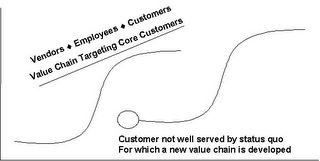
Markets are dynamic, and as they mature, some customers are not well served by the status quo. In some cases, an entrepreneur will identify how to deliver s simpler, cheaper, more convenient solution to these customers that creates a new, growing market. In some cases this new value proposition is so powerful that eventually it overthrows the original value chain. Think of Wal-Mart overthrowing Sears, and the PC overthrowing mainstream computers.
I have been involved in lots of companies an advisor, manager, and investor. I have been on both sides of this phenomenon, in the market leader that was being challenged and in the emerging company that was doing the attacking. Often the cost structure of the market leader makes it extremely difficult to serve these now customers with a cheaper, simpler, more convenient solution and still make money.
As the challenger becomes more successful and inflicts pain on the leader, people inside the leader become anxious and disparaging about this new emerging threat. You hear that these new customers just don't get it. They are unsophisticated. That the new upstarts are screwing up the market. That they are cockroaches. The customer is to blame for the problems the leader is experiencing.
Then you hear that the company just needs to work harder. Let’s get back to basics and focus on our fundamentals. Six sigma and other testing regimes are installed. But these leading companies will never succeed in this new market, no matter how hard they work or what they measure, unless and until they develop a new value that can be effectively delivered to these new customers.
I have come to believe that a similar phenomenon occurs in public education. The paradigm of the existing system is that schools will have considerable assistance from well educated parents in helping students with homework and studying at home. In South Carolina, half of students will not graduate from high school on time. If your family does not meet the educated, middle class paradigm the school was set up to serve, you tend to fail.
What is the answer from the public schools? Not that their paradigm does not serve students well who are not from educated, middle class families. Large organizations rarely admit that is the problem, rather they blame the customers. The parents of these children are to blame, because they are not involved with their kids in the way the schools are designed to work. Schools just throw up their hands in resignation; we can not meet the needs of these students because the parents don't get it.
What is the real problem? Just like Sears did not know how to serve customers in Bentonville, AK, existing public schools do not know how to reach students not well served by the status quo. This is where entrepreneurs are the most valuable in our society, creating new value to serve emerging markets of customers not well served by the status quo.
We desperately need school choice to unleash the power of entrepreneurs to meet the needs students failing in the current system. The entrepreneurial process is very difficult, with lots of starts and stops before someone finally gets it right. It is unrealistic that a system tuned to serving educated, middle class families is ever going to meet the needs of underserved students on its own, no matter how much money we spend or how much measurement we do.
When we place our bets, which we do every day with our tax dollars, let's bet on the educational entrepreneurs.
Saturday, May 07, 2005
George Fletcher to Lead SC Council on Competitiveness
Thursday, a friend of mine, George Fletcher, was elected Executive Director of the SC Council on Competitiveness. I think this is very encouraging and the shot in the arm that the Council needs to deliver on its potential.
George is a doer. In 2001, Clemson President Jim Barker called a meeting to discuss what we would do different if Clemson were located in Greenville. George asked to organize a committee to study having more Clemson research in Greenville. I participated on that committee, and we met for about a year. Ultimately the conversation led to what became the Clemson University Center for International Research. With partners Clemson, BMW, Michelin, IBM, and Microsoft, and a total of $112 million committed to date, this is the most important knowledge-based initiative in South Carolina today.
George also was the heart and soul behind the recent Greenville Vision 2025 process. This was an enormous effort to get many different organizations in Greenville together to begin to form a common vision of the community we want to create over the next couple of decades.
Neither CU-ICAR or Greenville Vision 2025 would exist today without the leadership of George Fletcher. The SC Council on Competitiveness could not have chosen better.
InnoVenture MicroBusiness
Over the past year, I have had numerous conversations about how to have more diverse participation in business organizations I am a part of, from InnoVenture to the Chamber. One of the recurring issues that comes up over and over is that most African-American and Hispanic businesses are micro-businesses, with four or fewer employees. Often the owner can not afford the time away from the company, or the financial cost of participation is too high, for an activity that is not directly relevant for their business today.
I have come to believe it is important to focus on the needs of micri-businesses, in order to prime the pipeline of the growing businesses of tomorrow, especially in the African-American and Hispanic communities. So if I can find a Chairman and Executive Committee willing to organize the event, I am interested in having an annual InnoVenture MicroBusiness Conference.
If you are interested in participating, please let me know.
Subscribe to:
Posts (Atom)